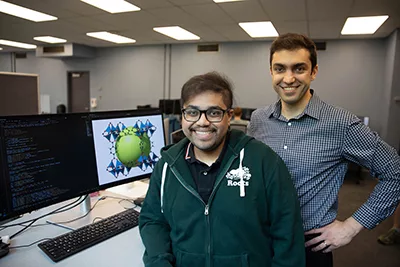
Alex Lathem, a graduate student at Rice University, has launched Pattern Materials, a startup focused on revolutionizing graphene production by making it faster, more affordable, and scalable. The company leverages Lathem’s proprietary laser-induced and flash graphene technologies, which enable the rapid creation of graphene and carbon nanotube-like patterns in a single step. These advanced materials, known for their exceptional conductivity, flexibility, and strength, have the potential to significantly enhance electronic devices such as sensors. Pattern Materials is already gaining traction, earning $134,500 and fourth place at the Rice Business Plan Competition, along with third place at Energy Venture Day during CERAWeek.
The technology was developed in the lab of Rice’s James Tour, professor of materials science and nanoengineering and the T.T. and W.F. Chao Professor of Chemistry, who discovered and has been innovating with graphene for more than a decade. He’s also an advisor to Pattern Materials.
“There’s a lot of graphene research out there now and it should be ready for commercialization – that’s the kind of bet that we’re making,” Lathem said.
To prepare for the pitch competitions, Lathem utilized Rice’s Liu Idea Lab for Innovation and Entrepreneurship (Lilie). Lilie is the home of experiential learning and co-curricular activities in entrepreneurship and innovation at Rice.
“We were still thinking too much like it was a thesis, and got a whole lot of feedback from investors saying ‘make it more clear what you’re doing,” Lathem said. “‘Focus on the product, focus on the solution.’”
Pattern Materials’ next focus is on working with sensor manufacturers to create pilot programs.
“Those are the key people we want to be working with, because our patterns basically could serve as the template or the backbone for those sensors,” he said. “In a sensor, there’s always some component that’s the actual sensitive material – that’s what graphene is really good for. Our intention is to replace that piece with our material, and so that will involve working with these manufacturers pretty closely to know what properties they need.”
The company plans to be based in Houston and work toward vertical integration. The city has a lot of interest in new technology and new manufacturing, Lathem said.
“The ceiling is very high for what we can do, the potential. We want to see how far we can take it, not just on domestic usage, but packaging,” he continued. “We believe in the material. We love the potential and we want to see how far we can take it and what impact we can have on not just domestic manufacturing, but sensor usage and making the world kind of a better, safer place in all the ways that sensors are used nowadays. And hopefully as well, it will be a great sort of example for what’s possible in Houston.”
For more information: Rice University