Researchers at the Massachusetts Institute of Technology (MIT), Cambridge, have developed a new way to probe inside an atom’s nucleus, using the atom’s own electrons as “messengers” within a molecule.
In a study in the journal Science, MIT physicists precisely measured the energy of electrons whizzing around a radium atom that had been paired with a fluoride atom to make a molecule of radium monofluoride. They used the environments within molecules as a sort of microscopic particle collider, which contained the radium atom’s electrons and encouraged them to briefly penetrate the atom’s nucleus.
Typically, experiments to probe the inside of atomic nuclei involve massive, kilometers-long facilities that accelerate beams of electrons to speeds fast enough to collide with and break apart nuclei. The team’s new molecule-based method offers a tabletop alternative to directly probe the inside of an atom’s nucleus.
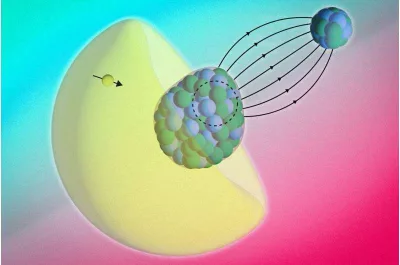
Within molecules of radium monofluoride, the team measured the energies of a radium atom’s electrons as they pinged around inside the molecule. They discerned a slight energy shift and determined that electrons must have briefly penetrated the radium atom’s nucleus and interacted with its contents. As the electrons winged back out, they retained this energy shift, providing a nuclear “message” that could be analyzed to sense the internal structure of the atom’s nucleus.
The team’s method offers a new way to measure the nuclear “magnetic distribution.” In a nucleus, each proton and neutron act like a small magnet, and they align differently depending on how the nucleus’s protons and neutrons are spread out. The team plans to apply their method to precisely map this property of the radium nucleus for the first time. What they find could help to answer one of the biggest mysteries in cosmology: Why do we see much more matter than antimatter in the universe?
“Our results lay the groundwork for subsequent studies aiming to measure violations of fundamental symmetries at the nuclear level,” says study co-author Ronald Fernando Garcia Ruiz, who is the Thomas A. Franck Associate Professor of Physics at MIT. “This could provide answers to some of the most pressing questions in modern physics.”
The study involved collaborators from multiple institutions including the Collinear Resonance Ionization Spectroscopy Experiment (CRIS) at CERN in Switzerland, where the experiments were performed.
Peering inside the nucleus of a radium atom to investigate fundamental symmetries is an incredibly tricky exercise. The team realized that by placing a radium atom in a molecule, they could contain and amplify the behavior of its electrons.
“We now have proof that we can sample inside the nucleus,” Garcia Ruiz says. “It’s like being able to measure a battery’s electric field. People can measure its field outside, but to measure inside the battery is far more challenging. And that’s what we can do now.”
Image – This image depicts the radium atom’s pear-shaped nucleus of protons and neutrons in the center, surrounded by a cloud of electrons (yellow), and an electron (yellow ball with arrow) that has a probability to be inside the nucleus. In the background is the spherical nucleus of a fluoride atom, which joins to form the overall molecule of radium monofluoride. Courtesy of the researchers/Massachusetts Institute of Technology.
************
For more information:
Massachusetts Institute of Technology