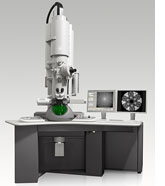
FEI Co., Hillsboro, Ore., introduces the Tecnai Femto ultrafast transmission electron microscope (UEM), enabling scientists to explore ultrafast events and processes that occur at the atomic and molecular spatial scale over time spans measured in femtoseconds (10-15 seconds). These include such fundamental processes as the absorption of light energy and its transformation into heat or mechanical changes (photoactuation) and the crystallization or recrystallization of materials.
The Tecnai Femto is the first system to commercialize the patented ultrafast electron microscopy technology pioneered by Nobel laureate Prof. Ahmed Zewail at the California Institute of Technology. The first Tecnai Femto UEM will be installed at the University of Minnesota in November 2013.
According to Dr. David Flannigan, Ray D. and Mary T. Johnson/Mayon Plastics assistant professor in the Department of Chemical Engineering and Materials Science at the University of Minnesota, and previously a member of Professor Zewail’s research team at Cal Tech, “Over the last decade microscope manufacturers such as FEI have developed instruments that have made observations of objects as small as individual atoms relatively routine. Ultrafast electron microscopy now gives us a powerful tool to look at the movements and changes that occur at this scale. Because the distances are so small, the time scale is also condensed–it doesn’t take very long to travel a nanometer or two. Using single-electron pulses, we have measured changes over time periods as short as tens of femtoseconds–those are millionths of a billionth of a second.”
“This is a truly revolutionary technology,” stated Trisha Rice, FEI’s vice president and general manager of the Materials Science Business Unit. “Until now, the only commercially-released instruments that could look at processes at this time scale were limited to observations of bulk materials. The Tecnai Femto UEM is the first to combine femtosecond time resolution with nanometer spatial resolution, allowing researchers to see the structural changes that occur at the atomic scale in response to the energetic stimuli.”
More information: