A research team at Lawrence Berkeley National Laboratory, Calif., has discovered a way to introduce a recoverable strain into bismuth ferrite of up to 14% on the nanoscale, larger than any shape-memory effect observed in a metal. Bismuth ferrite is a multiferroic compound comprised of bismuth, iron, and oxygen. It displays both ferroelectric and ferromagnetic properties, meaning it will respond to the application of external electric or magnetic fields. In this latest study, in addition to the conventional thermal activation, an elastic-like phase transition was introduced into bismuth ferrite using only an electric field.
“By achieving the shape-memory effect in an oxide material rather than a metal alloy, we eliminate the surface issues and enable integration with microelectronics,” says Jinxing Zhang, a post-doc for this study under Ramamoorthy Ramesh of Berkeley Lab’s Materials Sciences Division and now a faculty member at Beijing Normal University.. “Our bismuth ferrite also displays an ultra-high work function density during actuation that is almost two orders of magnitude higher than what a metal alloy can generate.
“Our bismuth ferrite not only displayed the champion shape-memory value, it was also far more stable when reduced to nanometer size than shape-memory alloys,” says says Dr. Zhang. “Also, because our bismuth ferrite can be activated with only an electrical field rather the thermal fields needed to activate shape-memory alloys, the response time is much faster.”
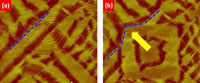
The AFM image shows a recoverable phase transformation in a bismuth ferrite film introduced by an applied electric field. The dashed blue line shows the relocation of the phase boundaries. The shape-memory effect is the metallic equivalent of elasticity, in which a solid material “remembers” and recovers its original shape after being deformed by an applied stress. In the past, this has always involved heating.