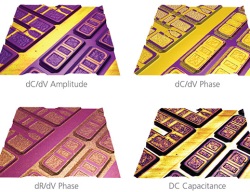
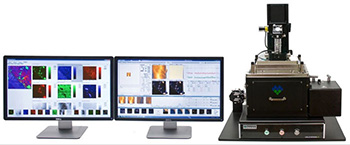
Asylum Research, Santa Barbara, Calif., an Oxford Instruments company, has developed Scanning Microwave Impedance Microscopy (sMIM). This is an atomic force microscopy technique that enables nanoscale mapping of permittivity and conductivity with unprecedented sensitivity and resolution on any material, including conductors, semiconductors, and insulators.
The sMIM is the latest tool in Asylum’s “Beyond Topography” initiative, which seeks to provide valuable nanomechanical and nanoelectrical information in addition to high resolution AFM topography The sMIM incorporates electronics and proprietary AFM probe technology developed by PrimeNano Inc., and is available integrated exclusively with Asylum Research MFP-3D and Cypher AFMs.
Nanoelectrical AFM modes have long been used in microelectronics R&D applications because they can provide valuable insight into device structure, function and failure. However, most conventional modes have been limited to measuring either resistance or capacitance, and have required laborious sample preparation. However, sMIM is a dramatic improvement on these technologies because it senses sample variations in both conductivity (resistance) and permittivity (capacitance), while requiring only minimal sample preparation. These capabilities also make sMIM applicable to a broader range of samples, including ferroelectrics, piezoelectrics, and low-dimensional nanomaterials such as graphene, boron nitride, and molybdenum disulfide.
“The sMIM is the biggest advance in AFM nanoelectrical measurements that I’ve seen in my 12+ years working in this field,” said Keith Jones, Applications Scientist at Asylum Research. “Being able to visualize both conductivity and permittivity at the same time gives us a more complete picture of our samples. The sensitivity and resolution of the measurements is also way beyond the competitive technologies I have used throughout my career.”
http://www.AsylumResearch.com/sMIM