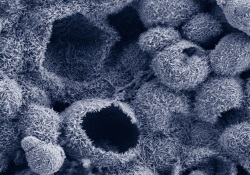
Researchers at Fraunhofer ICT, Germany, have developed a coating in which air-filled aluminum oxide microspheres protect against heat and oxidation. The coating consists of an outer topcoat containing conjoined aluminum oxide spheres. Researchers make the topcoat by mixing the spheres with a viscous liquid bonding agent, producing a slurry that can be sprayed or brushed onto the metallic component.
“When the outer side of a part is exposed to temperatures of 1000°C, the spheres reduce temperatures on the part’s inner side to under 600°C,” explains coatings expert Dr. Vladislav Kolarik from the ICT’s Energetic Systems department. This will provide protection to gas and steam turbines used for energy generation, combustion chambers, waste incinerator generators, and reactors in the chemical and petrochemical industries.
The basic coating layer forms by interaction of aluminum particles and the metallic component. This is done by depositing aluminum powder on the surface of the metal and heating it all up to a suitable temperature over several hours. The result is an aluminum-rich coating on the component’s surface that protects against oxidation at high temperature. The innovation here is that during the heat treatment, the aluminum particles that do not adhere to the surface become oxidized and form a layer of hollow aluminum oxide spheres. The scientists have refined the process so they can produce both coating layers in the required thickness at the same time.
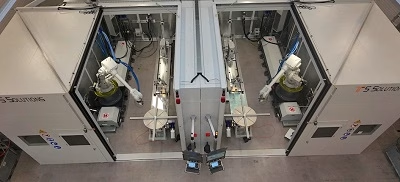
“We’re currently in the process of putting the findings from the EU-funded PARTICOAT project into practice. This involves coating bigger and bigger components without exceeding the temperature limits for each application area. At the same time we’re trying out techniques to automate the whole coating process,” says Dr. Kolarik.