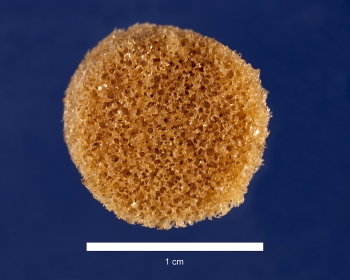
A newly developed shape-shifting material that molds itself to fill gaps in bone while promoting bone growth could more effectively treat defects in the facial region, according to researchers at Texas A&M University, College Station. Melissa Grunlan, associate professor in the university’s Department of Biomedical Engineering, is working with colleagues at Texas A&M and Rensselaer Polytechnic Institute, Troy, N.Y. Together they created a polymer foam that is malleable after treating with warm saline, allowing it to precisely fill a bone defect before hardening into a porous, spongelike scaffold that promotes new bone formation.
The team envisions the material as a treatment for cranio-maxillofacial bone defects—gaps in bone occurring in the head, face, or jaw areas. The polymer foam acts as a scaffold while promoting healing by allowing bone cells to migrate into the area and repair damaged tissue. Ultimately the scaffold dissolves, leaving behind new bone tissue, says Grulan. For more information: Melissa Grunlan, 979.845.2406, [email protected], engineering.tamu.edu/biomedical.
Image caption — A new material that changes shape upon heating could help heal bone lesions caused by injuries, tumor removal or birth defects, such as cleft palates. (The white bar is 1 cm, or less than half an inch long.) Courtesy of Melissa Grunlan.