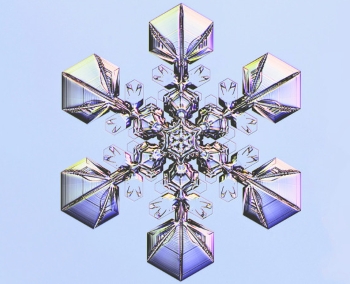
California Institute of Technology physicist Ken Libbrecht studies the science and beauty of snow crystals. In his lab, he creates countless snowflakes to investigate and explain how subtle changes in temperature, pressure, and humidity give rise to an impressively varied menagerie of intricate snowflake forms.
His website features some of his most recent micrographs documenting the fascinating and beautiful results of his investigations. The photo galleries include samples of some common types of snowflakes: needles, stellar dendrites, stellar plates, columns, sectored plates, and capped columns.
For the record, Libbrecht employs no Photoshop trickery to create his colorful images. Instead, he shines colored lights in from different angles behind the crystal. The ice acts like a complex lens and bends the light to accentuate structural details. Learn more about his techniques.
And, it turns out, snowflakes are picky about the temperatures at which they’ll grow; not every spot on the snowflake-growing fishing line is conducive to creating a crystal. But why is not understood at all and neither is why the growth of ice depends so sensitively on temperatures.
It is simple, inexpensive, and fun to grow your own snow crystals, using little more than some dry ice, a plastic soda bottle, and some styrofoam cups. Check out Libbrecht’s recipe for creating a white Christmas at his Snow Crystals website.
Image caption — This sectored plate snowflake was created in a lab on a hot summer day. Courtesy of Ken Libbrecht.