University of California San Diego‘s efforts to produce innovative and sustainable solutions to the world’s environmental problems have resulted in a partnership with the region’s surfing industry to create the world’s first algae-based, sustainable surfboard.
The project began when undergraduate biology students working in the laboratory of Stephen Mayfield, a professor of biology and algae geneticist at UC San Diego, joined a group of undergraduate chemistry students to solve a basic chemistry problem: How to make the precursor of the polyurethane foam core of a surfboard from algae oil. Polyurethane surfboards today are made exclusively from petroleum.
“Most people don’t realize that petroleum is algae oil,” explains Mayfield. “It’s just fossilized, 300 million to 400 million years old and buried deep in underground.” Students from the laboratories of Michael Burkart, a professor of chemistry and biochemistry, and chemistry professor Robert “Skip” Pomeroy first determined how to chemically change the oil obtained from laboratory algae into different kinds of polyols. Mixed with a catalyst and silicates in the right proportions, these polyols expand into a foam-like substance that hardens into the polyurethane that forms a surfboard’s core.
Although the board’s core is made from algae, it is pure white and indistinguishable from most plain petroleum-based surfboards. That’s because the oil from algae, like soybean or safflower oils, is clear.
“In the future, we could make the algae surfboards ‘green’ by adding a little color from the green algae to showcase their sustainability,” says Mayfield. “But right now we wanted to make it as close as we could to the real thing.”
The algae surfboard not only represents the kind of collaboration that is the hallmark of UC San Diego, but the fusion of biotechnology, surfing, and environmentally conscious thinking that has made the La Jolla campus and its environs such a desirable place to work and live for scientists, innovators, and those who cherish the coastal environment.
“As surfers more than any other sport, you are totally connected and immersed in the ocean environment,” he explains. “And yet your connection to that environment is through a piece of plastic made from fossil fuels.” But now surfers can have a way to surf a board that, at least at its core, comes from a sustainable, renewable source. “In the future, we’re thinking about 100% of the surfboard being made that way—the fiberglass will come from renewable resources and the resin on the outside will come from a renewable resource,” Mayfield says.
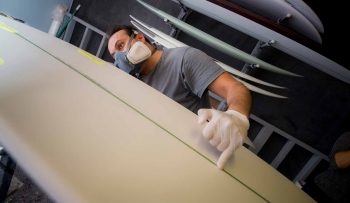
Image caption — Workers at Avila Surfboards, Oceanside, Calif., prepare the world’s first algae surfboard blank for the application of a fiberglass shell. Courtesy of Erik Jepsen/UC San Diego Publications.