Sinter Hardening
Sinter hardening refers to a process in which the cooling rate in the cooling zone of the sintering furnace is fast enough to transform a significant portion of the powder metal steel matrix into martensite.
The sinter hardening route has become increasingly widespread due to its cost effectiveness. Advantages include:
-
· Eliminating secondary quench hardening treatment
· Better dimensional control due to less severe quench
· Elimination of retained quench oil in pores leading to fewer steps during tempering
· Oil does not have to be removed to perform secondary operations such as plating - Disadvantages of sinter hardening include:
-
· Difficult or impossible machining due to high hardness
· Need for tempering operation to relieve stresses and improve dynamic mechanical properties
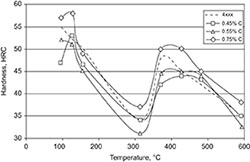
· Impractical sizing or other secondary operations due to the high apparent hardness - Vacuum sinter hardening and gas quenching shows some promise as another method to achieve higher hardness. A comparison of vacuum sinter-hardened materials to wrought 4600 steel is shown in the graph. PM steels were sintered for 2 hours at 1260°C (2300°F) in a hydrogen atmosphere, followed by a 2-bar helium gas quench. The time at each temperature is one hour. As the graph shows, hardness is comparable to the wrought equivalent.
Volume 4D, Heat Treating of Irons and Steels ⇒ Heat Treating of Carbon and Low-Alloy Steels ⇒ Heat Treatment of Powder Metallurgy Steels ⇒ Sinter Hardening