In a recent talk at the ASM Houston Chapter meeting, Johnson Space Center’s Materials & Processes Orion System Manager Dr. Lucie Johannes discussed how NASA’s next exploration vehicle, the Orion spacecraft, will take crewmembers beyond low-earth orbit for the first time since the Apollo Program. Lockheed Martin engineers at NASA’s Michoud Assembly Facility in New Orleans, Louisiana, recently completed several key structural welds to the pressurized crew vehicle.
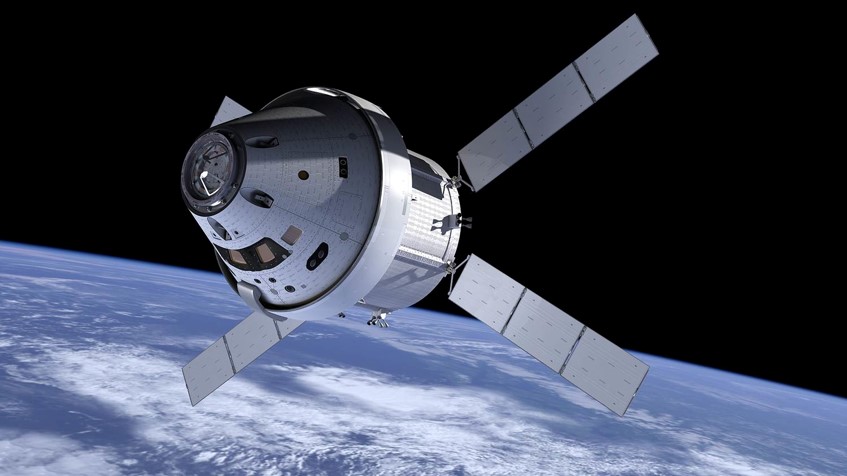
Artist Drawing of Orion Spacecraft
Self-reacting friction stir welding (SR-FSW) is being used to join Orion’s aluminum cone panels, bulkheads, tunnel, and barrel together. Orion’s first spacecraft design, the Ground Test Article (GTA) utilized 33 welds. The Engineering Flight Test-1 (EFT-1) which orbited the earth twice then splashed down in the Pacific Ocean on Dec 05, 2014 utilized 19 welds. Exploration Mission 1 (EM-1), slated for launch in 2018 further reduced the total number of structural welds from 19 to7, reducing the vehicle mass by 700 pounds.
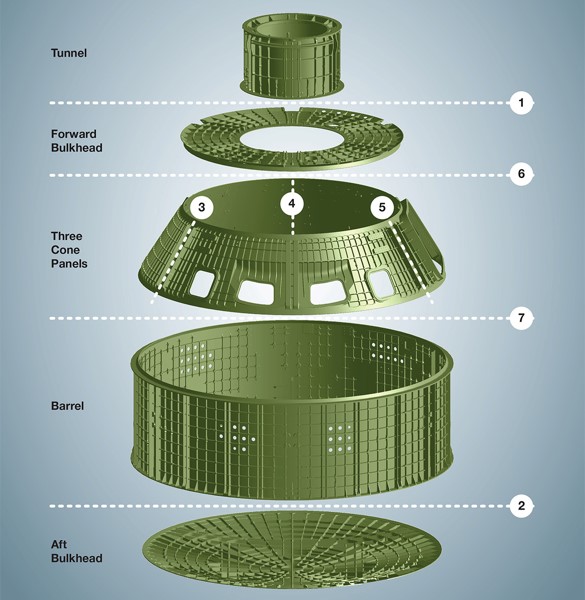
EM-1 Weld Locations
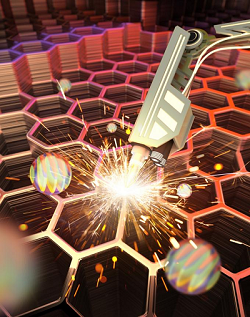
SR-FSW is a solid-state joining process that uses a spinning tool to heat and forge two pieces of metal together. Unlike fusion welding which requires controlling numerous parameters (like purge gas, voltage, amperage, wire feed, travel speed, shield gas, and arc gap), SR-FSW has only three primary processes to control: rotation speed, travel speed, and pressure. SR-FSW decreases production costs, makes repairs easier, and produces a stronger weld joint compared to fusion welding. Increased joining strength also allows design engineers to further reduce vehicle mass.
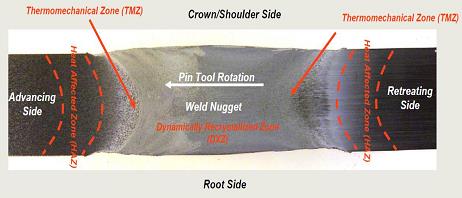
Metallographic Cross Section of SR-FSW Aluminum
James E. Martinez
2015 – 2017 Vice President
International Metallographic Society Inc.
An Affiliate Society of ASM International