Because of their tungsten content, F-steels form hard tungsten carbides. In combination with the usual heat treatment procedures, they exhibit the highest hardness of all low-alloy cold-work tool steels, both in the as-quenched condition and at low tempering temperatures.
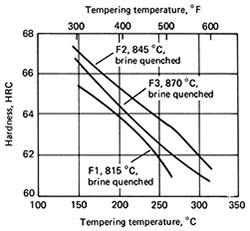
Because tools made of the F-steels (cold drawing dies, for example) are used mainly for applications requiring wear resistance, they are usually placed in service at or near their maximum hardness. Therefore, tempering temperatures higher than 400°F are seldom used. The effects of tempering temperature on hardness for the F1, F2, and F3 steels are shown in the graph, which shows tempering characteristics of carbon-tungsten special-purpose tool steels tempered for two hours after being brine quenched.
Volume 4D, Heat Treating of Irons and Steels -> Tool Steels -> Heat Treating of Cold-Work Tool Steels—Low- and Un-Alloyed Water and Oil Hardening Steels -> Carbon-Tungsten Special-Purpose Tool Steel