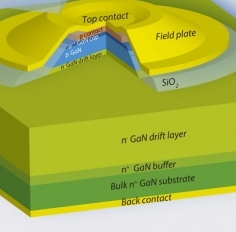
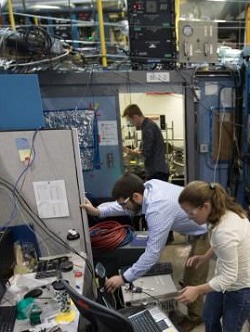
Cornell University, Ithaca, N.Y., the University of Notre Dame, South Bend, Ind., and the semiconductor company IQE, Cardiff, Wales, have assembled an engineering team that has created gallium nitride (GaN) power diodes capable of serving as building blocks for future GaN power switches. Applications span nearly all electronic products and electricity distribution infrastructures.
All electronics rely on power semiconductor devices to control or convert electrical energy. Silicon-based semiconductors are rapidly approaching their performance limits, so materials such as GaN are being explored as potential replacements that may render silicon switches obsolete.
However, GaN is notorious for its defects and reliability issues. So the team zeroed in on devices based on GaN with record-low defect concentrations to probe GaN’s ultimate performance limits for power electronics. They describe their results in a paper in the journal Applied Physics Letters, from AIP Publishing.
“Our engineering goal is to develop inexpensive, reliable, high-efficiency switches to condition electricity — from where it’s generated to where it’s consumed within electric power systems — to replace old, bulky, and inefficient technologies,” said Zongyang Hu, a postdoc working in Prof. Grace Huili Xing’s research group within the School of Electrical and Computer Engineering at Cornell University. “GaN-based power devices are enabling technologies to achieve this goal.”
The team examined semiconductor p-n junctions, made by joining p-type (free holes) and n-type (free electrons) semiconductor materials, which have direct applications in solar cells, light-emitting diodes (LEDs), rectifiers in circuits, and numerous variations in more complex devices such as power transistors. “For our work, high-voltage p-n junction diodes are used to probe the material properties of GaN,” Dr. Hu explained.
The work is significant because many researchers around the globe are working to find ways to make GaN materials reliable for use within future electronics. Due to the presence of defects with high concentrations in typical GaN materials today, GaN-based devices often operate at a fraction of true GaN capabilities.
The development at Cornell is the first report of GaN p-n diodes with near-ideal performance in all aspects simultaneously: a unity ideality factor, avalanche breakdown voltage, and about a two-fold improvement in device figures-of-merit over previous records.
The team’s work is part of the U.S. Department of Energy’s (DOE) Advanced Research Projects Agency-Energy (ARPA-E) “SWITCHES” program, monitored by Dr. Timothy Heidel. ” Beyond the DOE ARPA-E project, the team is open to collaboration with any researchers or companies interested in helping drive GaN power electronics to its fruition.