For years, scientists have been trying to emulate photosynthesis which could provide a clean, renewable source of energy to help satisfy society’s growing demands. For artificial photosynthesis to become a viable alternative to fossil fuels, the efficiency and speed of water oxidation must be improved.
A team of scientists from the DOE’s Brookhaven National Laboratory, Upton, N.Y., Adam Mickiewicz University, Poland, and Baruch College, City University of New York, synthesized two new molecular catalysts for water oxidation. The catalysts—complexes of ruthenium surrounded by binding molecules (ligands) containing phosphonate groups—accelerate the formation of the oxygen-oxygen bond, usually the most energy-intensive and slowest step of water oxidation. Initial studies demonstrate that these ruthenium complexes could offer a low-energy pathway to faster water oxidation.
“Storing solar energy as hydrogen fuel or carbon-based fuels like methanol requires catalysts that can oxidize water at fast rates, with high efficiency, and for long periods of time,” says Javier Concepcion at Brookhaven Lab. “Our ruthenium complexes catalyze the oxygen-oxygen bond formation faster than any other known catalysts, generating hundreds of oxygen molecules per molecule of catalyst per second. With these catalysts, the electrical potential required to start the reaction is approximately 10 times less than that of a AA battery.”
Forming the oxygen-oxygen bond
In water oxidation, four protons and four electrons—required in a subsequent reaction to convert carbon dioxide into usable energy—are removed from two water molecules, forming an oxygen-oxygen bond. For water oxidation to occur, the bonds between the hydrogen and oxygen atoms in the two water molecules must be broken. In the case of artificial photosynthesis, a chemical catalyst triggers this molecular breakup.
“Water is a very stable molecule, so getting two water molecules to react with each other is very difficult,” explains Yan Xie in Brookhaven’s artificial photosynthesis group. “Our ruthenium complexes provide the reactivity needed to break those bonds.”
One of the water molecules binds to the ruthenium complex and loses protons as the complex is oxidized (loses electrons), resulting in an electron-deficient ruthenium-oxo group. Then, with the assistance of a phosphonate group, the other water molecule reacts with this highly reactive ruthenium-oxo to release molecular oxygen (O2).
“The phosphonate group accepts protons, or hydrogen ions, from water,” says Concepcion. “It is positioned near the active site of the ruthenium complex where water oxidation occurs. Incorporating the phosphonate group and ruthenium in a single complex makes it easy for the water molecule to find that one site and react.” Eventually, the protons are transferred from the phosphonate group to the surrounding solution.
Ruthenium complex electrochemistry
To determine the efficiency and rate of water oxidation with the ruthenium catalysts, the electrochemistry of each oxidation state was studied by applying different voltages and measuring the amount of current flowing through the system at various pH values.
“The voltage at which catalysis starts tells you about the energy efficiency of water oxidation, while the current tells you how quickly water oxidation is occurring,” says Concepcion. “Our ruthenium complexes minimize energy loss as heat, both in terms of voltage and rate that would be required for the catalyst, if incorporated into a device, to make use of all incoming sunlight.”
The team also used computational modeling to study the activation parameters—the energy and molecular order—required to break and make bonds during the key reaction between the water molecule and the ruthenium-oxo group.
The computational studies showed why the phosphonate group resulted in faster catalysis. “Phosphonate is a good proton acceptor, so it energetically favors the reaction. Because it is part of the ligand, it is already positioned and ready to interact with water, removing the need for a more ordered arrangement of molecules,” says Concepcion.
From separate studies, scientists were able to tell that one of the oxidation steps—not the oxygen-oxygen bond formation step—was limiting the rate of the catalysis. The team is now developing second-generation catalysts to optimize this step. Eventually, they hope to make equally reactive catalysts using metals such as iron and cobalt that are more abundant and less expensive than ruthenium, but whose chemistries are much more complicated.
“By incorporating these catalysts into systems capable of absorbing sunlight and combining them with catalysts that reduce carbon dioxide or water into fuels, artificial photosynthesis could become a practical approach for storing solar energy as fuels,” says Concepcion.
The research was supported by the DOE Office of Science.
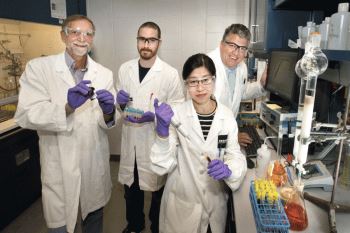
Image caption — Left to right: Brookhaven Lab research collaborator David Szalda, Baruch College; David Shaffer, Yan Xie, and Javier Concepcion, Brookhaven Lab. Not pictured: Anna Lewandowska-Andralojc, Adam Mickiewicz University.