The next generation of nanosubmarines has been upgraded with tags that fluoresce longer allowing them to be tracked for greater periods while being driven through solutions. The single-molecule vehicles may someday be used to deliver drugs or other cargo, says James Tour, chair in chemistry and professor of computer science and of materials science and nanoengineering at Rice University who introduced the technology last year.
The first nanosub, USN-1, could be monitored but not imaged by a technique that would irradiate it with light for very short times. But that did not provide any information about the submersible’s trajectory, says Víctor García-Lopéz, a former Rice graduate student and now postdoctoral researcher at ETH Zurich.
The latest model, the 334-atom USN-2, can be viewed by single-molecule microscopy for at least 1.5 seconds, long enough for 30 frames of video. “We can now track the trajectory of a single nanosubmersible,” Tour says. “It should lead to a better understanding of how these vehicles move.”
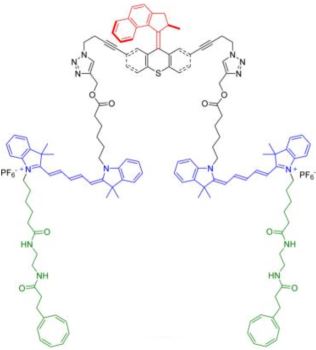
Cyclooctatetraene (COT) was attached to the molecule’s body while a motor kept them from bleaching, which quenches fluorescence. The light-driven motor is a tail-like ligand that spins about a million times per second. The new subs, like the originals, are capable of moving 15 m/s over nanoscale distances, based on the thrust provided by each turn of the rotating motor.
Between the frequent collisions that stop their forward motion, Tour says, they are “the fastest-moving molecules ever seen in solution.” The nanosubmarines still cannot be steered in the traditional sense, but researchers are satisfied for the moment with achieving “enhanced diffusion” that lets them figure out how to move a one-molecule vehicle in a solution of similarly sized molecules. “The next step is to track these nanosubmarines in solution and see if we can use them to deliver cargo or interact with cells,” Tour says.
Other researchers from Rice and from Toho University in Japan, and Tel Aviv University are coauthors of the study that was funded by the National Science Foundation, the Ministry of Education, Culture, Sports, Science and Technology of Japan, the Yamada Science Foundation, the Israel Science Foundation, and the European Research Councils.
Image caption — A new version of the molecule strengthens its fluorescent response for better tracking. Atoms in red make up the light-activated motor. Courtesy of Tour Group/Rice University.