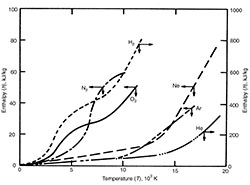
The graph shows the time-temperature-transformation (TTT) curve for an unstabilized 430-type alloy with carbon plus nitrogen of 0.08%. Stabilization is generally considered as the simple gettering of carbon and nitrogen by a suitable carbide former such as titanium or niobium.
For example, if carbon and nitrogen are kept as low as possible and a stoichiometric amount of titanium is available (i.e., greater than about four times the carbon plus nitrogen), then essentially all carbon is removed from solution (below 2280°F).
However, the stabilization formula in various specifications is more than four times the carbon plus nitrogen, because experimentally it has been found that sometimes understabilization occurs. This is due to the influence of oxygen and sulfur having already formed compounds with the titanium, and less importantly to kinetic factors that have prevented TiC formation.
Volume 4D, Heat Treating of Irons and Steels -> Heat Treated High-Alloy Steels -> Heat Treating of Ferritic Stainless Steels -> Stabilization