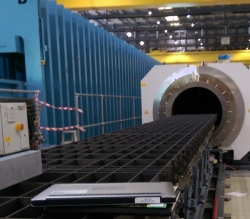
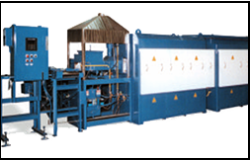
The European Organization for Nuclear Research (CERN), Geneva, announces that it has received a 105-foot-long furnace for the heat treatment of niobium-tin (Nb3Sn) superconducting coils that will be installed in the Future Circular Collider. The furnace completes the equipment required for the production of superconducting coils, which are needed for the High-Luminosity LHC (HL-LHC) upgrade and future circular colliders.
Superconducting accelerator magnets are key for reaching higher energies and luminosities in particle accelerators.
The HL-LHC upgrade aims for magnetic fields up to 11 Tesla for the dipole magnets, while the Future Circular Collider study explores using magnets with a field of 16 Tesla, almost double the 8.3 Tesla of the superconducting magnets used in the LHC.
To reach these goals new superconducting materials are needed.
“Nb3Sn has been chosen for the next generation of superconducting magnets,” says Friedrich Lackner, a project engineer who supervises the coil production for HL-LHC. “The field achieved with this material can reach up to 16 Tesla. The production of such coils is complex, as we must first wind the coils and then carry out the heat treatment that allows the tin and niobium to react and convert to the superconducting Nb3Sn compound.”
After the material has undergone this heat treatment, it becomes very brittle, which is why this process is implemented after the winding process—the opposite to magnets in the LHC.
Called GL010000, the furnace will allow the heat treatment of coils up to 36 feet long, and can reach temperatures up to 1650°F, providing a sufficient margin for future challenges.
This treatment involves a two-week process during which the coils are raised to different temperature plateaus up to 1230°F. A special feature is that it is able to raise the coils to such high temperatures completely uniformly throughout the entire furnace, making sure one part does not heat more or less than another.
http://cds.cern.ch/record/2203181