The Akko Tower Wreck has been playing tricks with researchers for over 50 years. The shipwreck was discovered during the first maritime archeological survey conducted in Israel using remote sensing technology, in 1966, and bears the distinction of being the first shipwreck identified off the coast of Israel. But the shipwreck is also unique in another respect—to date, researchers have been unable to agree on its identity, and as time passed the mystery only seemed to become more opaque.
Now, a new study undertaken by Maayan Cohen, Deborah Cvikel, and Yaacov Kahanov at the University of Haifa, Israel, together with Dana Ashkenazi of Tel Aviv University, Adin Stern of Ben Gurion University, and Sabina Klein of Frankfurt University has uncovered the first scientific evidence from the shipwreck.
More than a hundred brass nails were found in the ship, most of them still embedded in the wooden hull components, while others were scattered inside the vessel. Two different types of nails were found, with lengths of approximately 10 cm and 6.5 cm, respectively.
Both types of nails underwent a series of tests that would not have been out of place in a forensic criminal investigation: Measurement of the density of the brass; fluorescent spectroscopic examinations using x-rays (XRF) examination of chemical composition; optical inspection using a light microscope and a scanning electron microscope to determine metal casting quality and the microstructure and structure of various parts of the nails; examination of rigidity; lead isotope analysis, and more. In the final test, two brass nails from the ship and two modern steel nails were hammered in order to examine how each nail penetrated different pieces of wood.
The nails’ microstructure and presence of silicon show that they had been manufactured using the sand casting method. Researchers found a high proportion of zinc and other substances in the alloy. The nails’ composition and rigidity reveal the manufacturing process, while isotope analysis identifies the most probable location in which they were made.
Drawing together all their findings, researchers concluded that the nails were manufactured in the first half of the nineteenth century, probably at a European foundry using raw materials from Britain. “In light of the research findings, we now believe that this is a European merchant vessel that sunk off the coasts of Akko at some time during the first half of the nineteenth century,” say researchers.
The findings were published in the journal Metallography, Microstructure, and Analysis. The International Metallographic Society (IMS) awarded the authors its prestigious Buehler Prize for the best metallurgical study published in 2015.
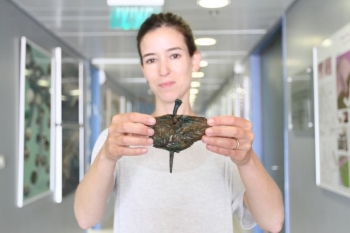
Image caption — Research student Maayan Cohen holds a nail from the Akko tower shipwreck. Courtesy of the University of Haifa.