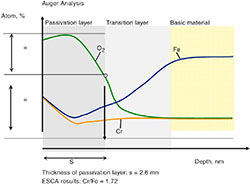
The presence of chromium causes the buildup of a chromium oxide layer that is impermeable and adherent to the alloy substrate, protecting it from any further oxidation or corrosion. Any scratch on this protective layer exposes the substrate to oxygen, and a new protective oxide layer is produced.
One important aspect of this layer is that it must be homogeneous throughout the surface of the alloy. Any differences from place to place could generate a difference of electrochemical potential, which could trigger a corrosion process.
Under normal conditions, the thickness of the protective passive layer is in the range of 1.5 to 2.5 nm, composed mostly of chromium oxide/hydroxide and iron/iron oxide. The strong affinity of chromium for oxygen promotes a very stable compound (Cr2O3) that suppresses any other reactions and thus stops corrosion.
The chemical stability of the passive layer depends on the type of surface-finishing treatment. Processes such as electrochemical polishing increase the surface concentration of chromium, promoting a thicker and more stable passive layer when compared to mechanically processed surfaces
Volume 4D, Heat Treating of Irons and Steels ⇒ Heat Treated High-Alloy Steels ⇒ Nitriding of Stainless Steels ⇒ Stainless Steels