The Navy Metalworking Center, Johnstown, Pa., reports that it has designed and fabricated a heat treating system for aluminum plate that reduces sensitivity to cracking in the aluminum superstructure of the U.S. Navy’s CG 47 class cruisers. Prior to this development, cracked aluminum superstructures required extensive repairs or replacement (i.e., removing and replacing the affected plate, as well as all of the outfitting obstructing the area).
The Navy Metalworking Center led a project to address the major contributor to the cracking – the sensitized microstructure in the 5456 aluminum-magnesium alloy used in the construction of the structure. An Integrated Project Team developed and demonstrated a portable heat treatment system that reverses the sensitization in the 5456 aluminum alloy, thereby restoring the affected material in the ship’s superstructure to a stabilized condition, which greatly reduces the propensity for cracking.
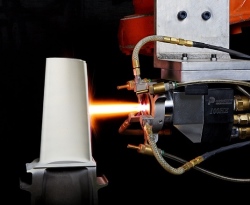
NMC conducted laboratory tests and finite element simulations to derive the optimized parameters for the reverse sensitization process. Based on this data, NMC designed and fabricated a prototype reverse sensitization unit (RSU), which imparts the necessary heat treatment to the aluminum plate in the CG class cruiser superstructure. The RSU was tested on laboratory sensitized panels, and a mockup of a CG superstructure was designed by NMC. The RSU was then demonstrated onboard two cruisers (one decommissioned, one active duty).
The final RSU prototype system was transitioned to PMS 407 for additional evaluation and use during maintenance intervals. A procurement specification was also developed by NMC, so that additional units may be built after successful implementation. The new process and RSU were implemented in September 2016 with the transition of the equipment to Ingalls Shipbuilding, the planning yard for CG repairs.
Reverse sensitization will give the Navy a low-cost alternative to the current process of cutting out and replacing the sensitized plate. The reverse sensitization repair process can save as much as $2.4M per CG 47 ship availability, resulting in a cost avoidance of as much as $43.2M for 18 ships. The Littoral Combat Ship program will also benefit from this improved technology at a conservative estimate of $500K avoidance per hull, resulting in an additional $4M in cost avoidance for the LCS hulls in service over the next five years.
https://www.navalmetalworking.org/