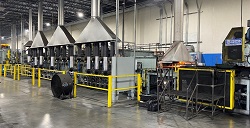
The University of Warwick, England, announces that engineers at its Advanced Steels Research Centre are evaluating belt casting technology as a way to cut steel production costs and reduce energy costs by a factor of three.
Belt casting is a near-net-shape casting process that produces strip needing minimal hot deformation to achieve the required product thickness. It is also very efficient because it can minimize or eliminate any reheating processes. The technology can also cast certain advanced high strength strip (AHSS) steel grades that are commercially attractive but cannot be produced by conventional casting techniques. These include TWIP (twinning induced plasticity) and TRIP (transformation induced plasticity), which have twice the strength and three times the ductility of conventional steels – as well as high-aluminum steels, which have a combination of good strength and lower density.
The Assure2 project team, led Prof. Claire Davis, has simulated belt cast microstructures, including dynamic direct observation of the solidifying steel at different cooling rates. The team has demonstrated that the microstructures are altered by the higher cooling rate of belt casting, compared to conventional slab casting, and that further beneficial modifications (such as reduction in grain size in high-aluminum steels) can be achieved by composition control.
In the Assure2 project, quantitative relationships between composition, process parameters and microstructure (and hence final product properties) are being established, taking into account the higher cooling rates of belt casting and the reduced hot deformation after casting to final thickness compared to conventional processing
http://www2.warwick.ac.uk/newsandevents/news/uk_steel_production/