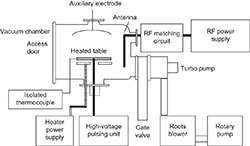
The fundamental difference between plasma nitriding (glow discharge) and plasma-immersion ion implantation (PIII) is that the latter relies on high-energy pulses (up to 45 kV) that promote a low-energy ion implantation in the target, but that is still less than the energy used in conventional ion implantation (>100 kV). A combination of target temperature and pulse voltage achieve the desired implantation profile.
The PIII process can be seen as a modification of the plasma nitriding process that provides control of individual operational parameters and thus improves the plasma treatment. Most systems use an RF plasma at frequencies up to 2.45 GHz to generate a nitrogen microwave plasma, independent of temperature and bias voltage at the target, in the same beneficial low-pressure atmosphere as the regular RF plasma treatment process.
Volume 4D, Heat Treating of Irons and Steels ⇒ Heat-Treated High Alloy Steels ⇒ Nitriding of Stainless Steels ⇒ Thermochemical Nitriding Treatments