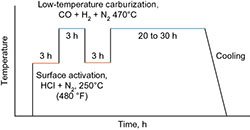
The recent advent of low-temperature gas nitriding (for the production of the S-phase in stainless steel) as opposed to regular high-temperature (above 550 °C) gas nitriding (of regular steel) had to find a way to remove the passive layer in this low-temperature condition.
Patent EP 1707646 B1 (2005): The process set forth in this patent uses a gaseous carbon donor compound (such as acetylene, ethylene, propane, butane, or carbon monoxide) with ammonia at temperatures greater than 570°F. It is carried out in a reactor vessel made of metal such as iron, nickel, cobalt, etc. The catalytic action of the reactor vessel will generate HCN. The HCN will depassivate the stainless steel surface through the following reactions:
2NH + C2H2 → 2HCN + 3H2
Cr2O3 + 6HCN → 2Cr(CN)3 + 3H2O
The carbon and nitrogen in 2Cr(CN)3 diffuse inward and form the nitrocarburized case, leaving a clean surface. The dewpoint must be kept below 40 °F to keep the metal surface being treated from repassivating, which means that the flow of gas must be continuous to eject excessive water formed during the depassivation and nitrocarburizing reaction. After the depassivation step, ordinary gas nitriding with NH3 + H2 + N2 atmosphere can be carried out as desired. The exhaust gas is burned and decomposed at the exit as nitrogen and CO2.
Volume 4D, Heat Treating of Irons and Steels ⇒ Heat Treated High-Alloy Steels ⇒ Nitriding of Stainless Steels ⇒ Thermochemical Nitriding Treatments