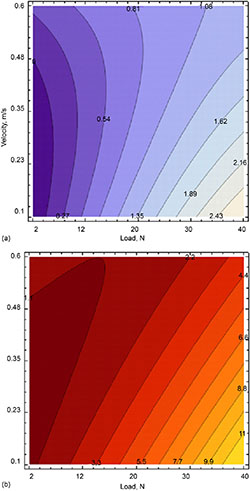
The images show wear maps for (a) treated and (b) nontreated 316 stainless steel. The T316 stainless steel was treated by low-temperature carburization.
The NT316 stainless steel was not treated (as received). Note the significant improvement in wear rates for treated vs. nontreated surfaces for the same loads and sliding velocities.
Dry sliding was tested against an Al2O3 ball, using varying contact loads from 2 to 40 N, and varying sliding velocity from 0.1 to 0.6 m/s (4 to 24 in./s). The total sliding distance was kept constant at 1 km (0.6 miles). The wear of the carburized specimens varied from 0 to 2.4 mm3 for 1 km of sliding, while the nontreated specimens varied from 1.1 to 11 mm3 for 1 km of sliding. Carburization reduces wear by over a factor of four under these conditions. In addition, the wear debris was analyzed and used to show that the nontreated material suffered from severe plastic deformation during the test, while the carburized material did not. The wear mechanism for nontreated material showed large plates, indicative of contact welding and stick-slip phenomenon, while carburized material showed minor surface wear debris.
Volume 4D, Heat Treating of Irons and Steels → Heat Treated High-Alloy Steels → Low-Temperature Carburization of Austenitic Stainless Steels → Wear Properties of the Low-Temperature Carburized Layer