Stanford University, Calif., announces that researchers Nina Vaidya and Olav Solgaard have developed a UV-curable polymer mixture that they applied to the surface of 3D printed parts, thereby reducing surface roughness to a few nanometers from the previous tens of microns.
The rough surfaces of 3D printed objects create scattering, which diminishes function of optical devices. “We tried a number of smoothing techniques, including flame polishing, acetone vapor polishing, spraying of polymer coatings, and mechanical polishing,” the researchers explain. “None of these methods create the nanometer scale smooth surfaces required for optical applications. To meet this surface roughness criterion, we coated the printed optics with a UV curable polymer mixture consisting of methacrylates, acrylates, and urethane-based polymers. This gel resulted in smooth and tough films that adhered well to the printed surfaces. When compared to a heat cure, a UV cure minimizes shrinkage of the polymer, which maximizes surface smoothness and conformal coverage.”
The researchers tested their technique with flat and parabolic mirrors, solar concentrator arrays, and immersion lenses used in microscopy of biological samples. Consistently, they were able to reduce the surface roughness to less than three nanometers after the smoothing process.
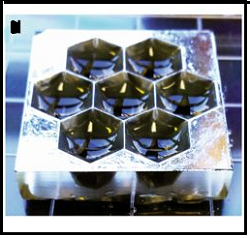
“Imaging with 3D printed parabolic mirrors were comparable to a diamond turned metal mirror and nearly diffraction-limited spot sizes were measured with modest incidence apertures,” the researchers state. “Solar concentrator hexagonal arrays were made using 3D printing, and they demonstrated five suns concentration across an acceptance angle of 40 degrees.”