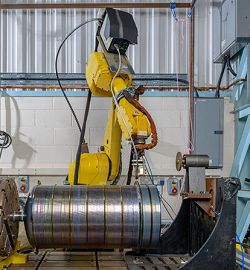
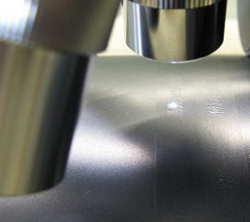
A European aerospace production team comprising Thales Alenia Space, Cranfield University, and Glenalmond Technologies announces the completion of the first full-scale prototype of an additively manufactured titanium pressure vessel to be used in future manned missions for space exploration.
The vessel is approximately 39 inches high and weighs about 19 pounds. Made of the titanium alloy Ti-6Al-4V, it was manufactured by the ”wire plus arc” additive manufacturing (WAAM) process, which Cranfield University has pioneered over the last decade. Thanks to being able to go straight from digital drawing to final structure, WAAM has integrated two individual pieces into a single part; eliminated the need for long-lead-time forgings; and substantially reduced the amount of waste material removed by machining.
If manufactured traditionally, the component would have required about 30 times more raw material than its final mass. By using the WAAM process, more than 440 pounds of Ti-6Al-4V has been saved for each component. There is room to improve this further, and Cranfield is working on innovative methods to deposit closer to the final thickness.
The WAAM shape was manufactured at Cranfield and then sent to Glenalmond Technologies, where it was stress-relieved, laser-scanned, machined, and inspected by an ultrasonic method. The final inspection was carried out by Agiometrix with a computer tomography scan for internal quality analysis and then an optical scanner, with Thales Alenia Space ensuring that the part met the mechanical requirements and specifications.
Following the checks, the project team was satisfied that the vessel fulfils the driving technical and quality requirements. The team is now proceeding to the building of a second prototype, to carry out a fine tuning of the whole manufacturing cycle, to demonstrate the repeatability and reliability of the process, and to push the implementation of the new approach into the flight hardware.