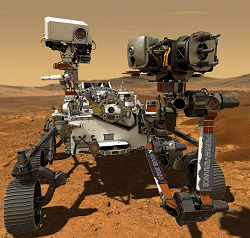
Curtiss-Wright’s Surface Technologies Division, Paramus, N.J., announces that its proprietary Microseal impingement lubricant coating process has been utilized on numerous components on NASA’s Mars 2020 Mission, many within the Sample Caching System on the Perseverance rover.
“We are very proud that our Microseal technology was selected by NASA to support this important mission,” says David Rivellini, Senior Vice President and General Manager, Curtiss-Wright Surface Technologies. “High performance in harsh conditions typical to space applications demands a reliable lubricant solution. The Microseal process outperforms conventional lubricants because it remains stable under extreme conditions and is resilient to shock, radiation, vibration, acceleration, and electrical discharge.”
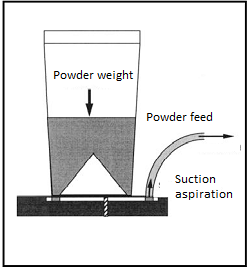
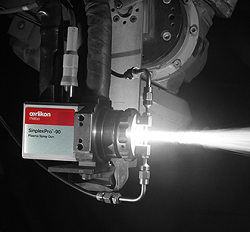
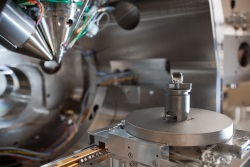
E/M Coating Services, a division of Curtiss-Wright, applies the Microseal process to surfaces using a specially designed, patented air tool that mixes micro-size particles. Particles leave the tool at speeds of nearly 600 feet per second, depositing a firmly adherent thin film that fills the voids. Due to the complex and proprietary nature of the equipment, Microseal application must take place at one of E/M Coating Services worldwide facilities.
The impinged coating is then cured, preferably for two hours at 300°F. Cure times and temperatures depend upon base material thermal properties. With some substrates, Microseal can cure in several days at room temperature.
Microseal is self-limiting. Regardless of the surface geometry of the treated part, once the coating reaches a thickness of fifty to eighty millionths of an inch, no further coating will be accepted. Coverage is uniform on all surfaces the air tool can reach, and the process is burnishable to original dimensions, eliminating the need for special machining or tolerance allowance.
www.curtisswright.com
https://cwst.com/microseal-impingement-coatings