The Fraunhofer Institute for Wind Energy Systems (IWES), Germany, has put the new Bearing Endurance and Acceptance Test Rig (BEAT1.1) facility into operation. As part of the Intelligent Bearing Amplitude Control (iBAC) research project, funded with €2.15 million by the German Federal Ministry for Economic Affairs and Energy, Fraunhofer IWES is testing 100 small-scale rotor blade bearings together with German project partners Enercon, Dataletics, and IMO GmbH & Co. KG.
The test results will create a database that can be used to develop methods for advanced pitch control and a condition monitoring system for blade bearings assisted by artificial intelligence. This should make it possible not only to achieve an optimal energy yield, but also to increase the system service life and optimize the operating conditions of the blade bearings.
The rotor blade bearings of a wind turbine are exposed to extreme loads and they are operated under conditions which are less than ideal for roller bearings in order to achieve the optimum energy yield. The oscillating operation results in adverse lubrication conditions between the rolling elements and bearing raceway, which can result in damage and failure of the blade bearings and, in turn, yield losses and repair costs for the operators. Therefore, the aim of the three-year project is to develop an intelligent condition monitoring system and combine it with an advanced control strategy in order to protect the blade bearings on the one hand, and, at the same time, optimize the expected energy yield and service life of the wind turbine.
“As part of the iBAC research project, we are developing solutions in cooperation with our project partners to protect rotor blade bearings from damage and, simultaneously, ensure optimal operation of wind turbines. We are combining our tests of the small-scale roller bearings with simulations of the entire wind turbine and, in doing so, aim to find an optimal compromise between bearing damage, energy yield, and the loads on the wind turbine. We use the data sets obtained from our tests to characterize the wear behavior of oscillating blade bearings and, at the same time, use them to train the AI-assisted blade bearing monitoring system,” says Arne Bartschat, group manager Slewing Bearings at Fraunhofer IWES and project manager.
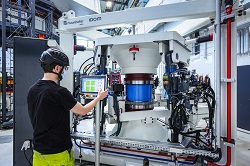
Image – The new sixth test rig BEAT1.1 in Hamburg-Bergedorf is dedicated to discovering how blade bearings can be successfully protected against damage. Courtesy of Ulrich Perrey – Fraunhofer IWES/Ulrich Perrey.
For more information:
Fraunhofer IWES
https://www.iwes.fraunhofer.de/en.html
Dataletics GmbH
https://dataletics.de
Enercon
https://www.enercon.de/home/
IMO Holding GmbH
https://www.imo.de/