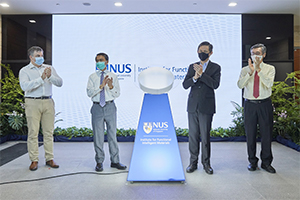
The National University of Singapore (NUS) has launched the Institute for Functional Intelligent Materials (I-FIM) – the world’s first institute dedicated to the design, synthesis, and application of Functional Intelligent Materials (FIMs). Co-directed by Nobel-Prize-winning materials scientist Professor Sir Konstantin Novoselov and Distinguished Professor Antonio Castro Neto, I-FIM will be the sixth research center of excellence (RCE) in Singapore, and the fourth RCE hosted at NUS.
I-FIM is supported with a total investment of $200 million over 10 years, with the Singapore Ministry of Education providing funding of $100 million and a matching contribution of an equivalent of $100 million from NUS. I-FIM will have over 100 researchers and Ph.D. students working in its cutting-edge research facilities housed in the new building on NUS Kent Ridge campus.
One of the major goals of I-FIM is to nurture the next generation of top research talent in Singapore and across the globe who will add to the unique strength of the Institute. 50 Ph.D. scholarships and more than 100 post-doctoral fellowships will be offered over the next 10 years, with an emphasis on the building of a Singaporean core and enhancing the pipeline of Singaporean talent in materials science under the tutelage of Professor Sir Novoselov.
I-FIM will create a library of designer materials – and develop systematic ways to describe them mathematically – as the building blocks of FIMs. Using these building blocks, the researchers at I-FIM will then develop a rulebook for predicting FIMs behavior, structure, and synthesis pathways. Using machine learning and robotics, the FIMs will be designed and synthesized with smart applications in mind. These applications could range from neuromorphic computers, to machine vision, smart membranes, smart catalysts, artificial tissues, and more.
Researchers in I-FIM are already working on creating such solutions on a materials level, developing materials that have internal functionalities. One example is a novel drug delivery agent based on 2D-electrolytes which will allow targeted drug delivery. This is particularly important for diseases like cancer, as the smart material only releases the drug payload when it detects the presence of a cancer cell, leaving the patient’s healthy cells unharmed. The 2D-electrolytes also show promise for other applications, such as artificial muscles and energy storage, which require materials to be responsive to environmental changes. Another example is emerging living materials composites that extract electrical power from bacteria through tight synergy between biotic and abiotic elements.
For more information: National University of Singapore