Researchers at the University of Science and Technology of China (USTC), collaborating with the Optoelectronic Research Center (ORC) at the University of Southampton, England, explored and reviewed the basic attributes of superoscillations and current applications of the technology for optics.
A superoscillatory optical field is one typical example of structured light. It has many important optical properties, including subwavelength intensity localization, fast phase variation and singularity, giant wavevector, and energy backflow. Under certain conditions, it is possible to achieve sub-wavelength focusing and imaging, breaking the traditional optical diffraction limit in the optical far field.
Its fast-changing phase properties make nanoscale lateral displacement detection possible. In combination with superoscillatory illumination and deep learning algorithm, the resolution of optical imaging and the accuracy of micro-nano displacement detection can be increased significantly.
In the review, published in Nature Review Physics, the researchers defined and explained the main characteristics of free-space band-limited superoscillatory fields in comparison to their counterparts in plasmonic near fields. They also summarized construction methods of superoscillatory lenses to focus light beyond the conventional diffraction limit, including binary masks, metasurface designs, and dynamic control with spatial light modulators or digital mirror devices.
They concluded emerging applications of superoscillations in far-field sub-diffraction imaging, nanometrology, label-free subwavelength bioimaging, static and dynamic superfocusing, the artificial intelligence enabled deeply subwavelength topological microscopy, and others could be possible.
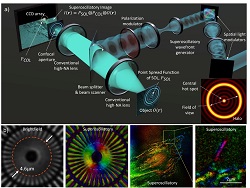
Among them, applications in nanometrology and nanoimaging with superoscillatory illumination were heavily discussed as well as artificial intelligence assisted topological microscopy. Bbenefitting from the fine structure of the superoscillatory fields, the next generation structured illumination microscopy and metrology devices could achieve nanometer precision and easy miniaturization.
Image – Optical superoscillation for label-free sub-diffraction bioimaging. Courtesy of: Nikolay ZHELUDEV and YUAN Guanghui
For more information:
Optoelectronic Research Centre at the University of Southampton
https://www.orc.soton.ac.uk/
University of Science and Technology of China
https://en.ustc.edu.cn