Researchers at the Johns Hopkins Applied Physics Laboratory (APL) in Laurel, Md., are developing coatings that can stand up to the rigors of hypersonic flight in the upper atmosphere. Building on decades of experience with hypersonics systems and the development of a custom heat shield coating for the thermal protection system (TPS) on NASA’s Parker Solar Probe, the work leverages APL’s ability to produce custom materials solutions to solve hard problems that stand between success and failure on real missions.
Hypersonic vehicles operating in the upper atmosphere are subject to speeds exceeding Mach 5 (five times the speed of sound) as well as temperatures well over 1,000 degrees Celsius, oxidation from the atmosphere, and tremendous aerodynamic shear loads. The leading edge (or nose) of these vehicles needs to be protected against these conditions, as do fins, control surfaces and apertures.
“We can’t just take Parker Solar Probe’s heat shield coating and apply it to a hypersonic vehicle, because space is an airless environment,” said Keith Caruso, a materials expert who was a key contributor to the Parker Solar Probe coating and is now involved in the Lab’s hypersonics coatings efforts. “But the upper atmosphere is not airless, so hypersonics vehicles have to deal with a very specific and demanding set of pressures that space vehicles don’t face,” he added.
The heat shield coating for Parker Solar Probe needed to be able to withstand the tremendous heat of the Sun, while also deflecting its light as much as possible. It had to be applied to a carbon substrate without chemically reacting, while maintaining its structural integrity and resisting changes in volume as well as in color. There were no existing coatings that could meet these unforgiving requirements, so APL scientists created one from scratch, layering three different ceramic oxides, as well as metals, in a variety of configurations and testing them until they produced a coating that was up to the challenge.
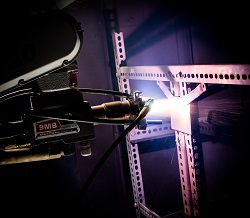
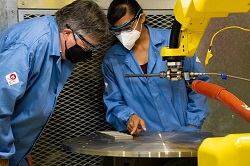
APL has developed a state-of-the-art thermal spray facility able to apply a wide range of liquid solutions, liquid suspensions and solid particulates, such as refractory ceramics. A high-velocity oxygen fuel torch enables rapid testing of tens of samples per day under Mach 2-3 and temperatures exceeding 2,000 degrees Celsius, with the ability to simulate the thermal profiles of flight trajectories of interest.
Since developing the TPS, the Lab has taken the lessons learned, and capabilities developed, and applied them to the challenge of developing coatings for the hypersonic environment. APL has produced a number of coatings that show promise in protecting leading edges and apertures of hypersonics vehicles and meet the requirements for offensive and defensive missions.
The Lab has also developed a modeling and simulation framework in collaboration with the Materials Architectures and Characterization for Hypersonics (MACH) program at the Defense Advanced Research Projects Agency (DARPA), to evaluate materials survivability in the context of specific hypersonics mission requirements.
Insights gained from the lab’s recent hypersonics work will continue to inform further development of materials in this and other extreme environments whether in space, the upper atmosphere, or any other environment inhospitable to matter.
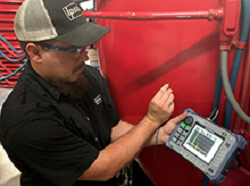
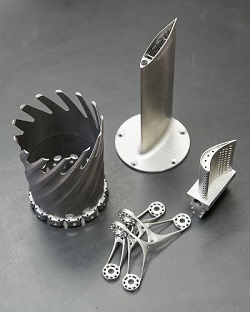
Image – APL has developed a state-of-the-art thermal spray facility able to apply a wide range of hypersonics coatings, including liquid solutions, liquid suspensions and solid particulates, such as refractory ceramics. Courtesy of: Johns Hopkins APL.
For more information:
The Johns Hopkins University Applied Physics Laboratory