Quantum sensors, which detect the most minute variations in magnetic or electrical fields, have enabled precision measurements in materials science and fundamental physics. But these sensors have only been capable of detecting a few specific frequencies of these fields, limiting their usefulness. Now, researchers at MIT have developed a method to enable such sensors to detect any arbitrary frequency, with no loss of their ability to measure nanometer-scale features.
The new method, for which the team has already applied for patent protection, is described in the journal Physical Review X, in a paper by graduate student Guoqing Wang, professor of nuclear science and engineering and of physics Paola Cappellaro, and four others at MIT and Lincoln Laboratory.
The new system the team devised, which they call a quantum mixer, injects a second frequency into the detector using a beam of microwaves. This converts the frequency of the field being studied into a different frequency — the difference between the original frequency and that of the added signal — which is tuned to the specific frequency that the detector is most sensitive to. This straightforward process enables the detector to home in on any desired frequency at all, with no loss in the nanoscale spatial resolution of the sensor.
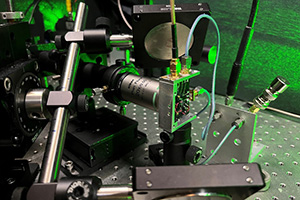
In their experiments, the team used a specific device based on an array of nitrogen-vacancy centers in diamond, a widely used quantum sensing system, and successfully demonstrated detection of a signal with a frequency of 150 megahertz, using a qubit detector with frequency of 2.2 gigahertz — a detection that would be impossible without the quantum multiplexer. They then did detailed analyses of the process by deriving a theoretical framework, based on Floquet theory, and testing the numerical predictions of that theory in a series of experiments.
The system may open up new applications in biomedical fields, according to Cappellaro, because it can make accessible a range of frequencies of electrical or magnetic activity at the level of a single cell. It would be exceedingly difficult to get useful resolution of such signals using current quantum sensing systems, she says. It may be possible using this system to detect output signals from a single neuron in response to some stimulus, for example, which typically include a great deal of noise, making such signals hard to isolate.
The system could also be used to characterize in detail the behavior of exotic materials such as 2D materials that are being intensely studied for their electromagnetic, optical, and physical properties.
For more information: MIT