 Although research alloy design and artificial intelligence has been ongoing for decades, Houlong Zhuang is now combining the two fields to forge a new path forward for materials scientists.
Zhuang’s vision is quickly gaining traction. In fact, the first research article he published about incorporating the use of artificial intelligence to design alloys has already been cited nearly 250 times since 2019.
The National Science Foundation, or NSF, grants the Faculty Early Career Development Program, or CAREER, award to early-career faculty members who have the potential to serve as academic role models in research and education and to lead advances in the mission of their department or organization.
Zhuang has been awarded a $537,000 CAREER award from the NSF to pursue this research in alloy design and quantum computing in his project “Developing Quantum Algorithms for High-Entropy Alloy Discovery.”
Alloy design involves the development of materials made with various metals blended together to create an ideal structural composition. Quantum computing operates by using the subatomic particles in physical matter to store information, then leverages this behavior using specialized hardware. The data drawn from quantum computing can be used to develop methods to mathematically describe the interactions between atoms.
Zhuang’s CAREER award project will build on his work combining alloy design and quantum computing to create quantum algorithms that aid researchers in developing new materials.
These algorithms will be implemented using quantum hardware that produce simulations of the bonds between select elements to predict the best possible combinations of elements to achieve a given material property. Researchers can then conduct experiments to validate if these predictions are correct.
As an assistant professor in the School for Engineering of Matter, Transport and Energy, Zhuang has collaborated with other researchers in the Ira A. Fulton Schools of Engineering and the ASU Quantum Collaborative to use quantum computing to answer questions about atomic interactions in a given chemical composition.
“This project aims to search for a ‘materials genome’ for alloy design using state-of-the-art quantum computers,” Zhuang says. “We are looking forward to identifying promising materials candidates that are suitable for sustainable energy applications like the future hydrogen economy.”
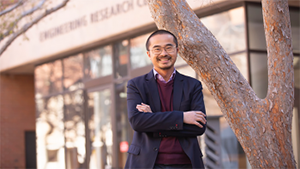
Photo: ASU Assistant Professor Houlong Zhuang has been recognized with a National Science Foundation CAREER award to continue his research at the intersection of alloy design and quantum computing. Photo by Erika Gronek/ASU
For more information: Arizona State University