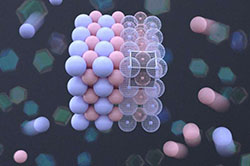
A team of New York University (NYU) researchers has created a new way to visualize crystals by peering inside their structures, similar to having x-ray vision. Their new technique—named Crystal Clear—combines the use of transparent particles and microscopes with lasers that allow scientists to see each unit that makes up the crystal and to create dynamic three-dimensional models.
“This is a powerful platform for studying crystals,” says Stefano Sacanna, professor of chemistry at NYU and the principal investigator for the study, published in the journal Nature Materials.
“Previously if you looked at a colloidal crystal through a microscope, you could only get a sense of its shape and structure of the surface. But we can now see inside and know the position of every unit in the structure.”
In their ongoing work to understand how colloidal crystals form, the researchers recognized the need to see inside these structures. Led by Shihao Zang, a Ph.D. student in Sacanna’s lab and the study’s first author, the team set out to create a method to visualize the building blocks inside a crystal.
They first developed colloidal particles that were transparent and added dye molecules to label them, making each particle possible to distinguish under a microscope using their fluorescence.
A microscope alone wouldn’t allow the researchers to see inside a crystal, so they turned to an imaging technique called confocal microscopy, which uses a laser beam that scans through material to produce targeted fluorescence from the dye molecules.
This reveals each two-dimensional plane of a crystal, which can be stacked on top of each other to build a three-dimensional digital model and identify the location of each particle. The models can be rotated, sliced, and taken apart to look inside the crystals and see any defects.
In order to validate their experiments on static and dynamic crystals, the team also used computer simulations to create crystals with the same characteristics, confirming that their Crystal Clear method accurately captured what is inside crystals.
Now that scientists have a method for visualizing the inside of crystals, they can more easily study their chemical history and how they form, which could pave the way for building better crystals and developing photonic materials that interact with light.
Image – The new technique allows researchers to see each particle that makes up colloidal crystals and to create dynamic three-dimensional models. Courtesy of Shihao Zang/NYU.
************
For more information:
New York University