A team of researchers at Ames National Laboratory, Ames, Iowa, has made important progress towards understanding the role of surface oxides in improving quantum computing circuits performance. Surface oxides are a primary cause of decoherence, or loss of quantum properties in quantum circuits.
The team is part of a larger effort by the Superconducting Quantum Materials and Systems Center (SQMS) to improve quantum computers.
SQMS center researchers are currently making a full investigation into the origin of decoherence. It can cause errors in quantum information and limit the time in which quantum information can be processed and stored and is one of the biggest obstacles to the success of quantum computing technology.
“There is a lack of systemic understanding,” said Ames lead scientist Lin Zhou. “What if we change one parameter during device fabrication? How will that change the material and the device performance?”
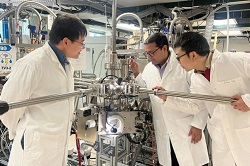
Zhou explained that they are using various techniques to analyze material down to the atomic level. With the data collected, they aim to establish connections between specific defects in a device and coherence loss.
“Different types of microscopes help us understand what’s happening inside the material from different perspectives, allowing us to diagnose why a material exhibits certain properties,” said Zhou, who mainly uses electron microscopy to investigate material structure and chemistry.
“We try to see how atoms are arranged and whether there are suspicious features or defects linked to the device’s performance deterioration.”
In one project, Ames Lab scientists worked with researchers from Rigetti Computing, Fermi National Laboratory, and the Illinois Institute of Technology. By using advanced imaging and analysis techniques, they explored the relationship between material microstructures and resulting properties. This approach helped clarify how material structures can result in decoherence.
In another project, Ames Lab scientists compared a niobium-based material with a tantalum-based material. Zhou explained that niobium (Nb) and tantalum (Ta) are good superconductive materials with many similarities. But through their work, they unexpectedly found structural differences between the two that showed devices made with Ta film had better performance.
“It’s a bottom-up approach,” said Zhou. “We start by understanding the materials from the atomic level and applying that understanding to influence material growth and performance.”
This research is discussed in two papers: “Structure and Formation Mechanisms in Tantalum and Niobium Oxides in Superconducting Quantum Circuits” is published in ACS Nano and “Exploring the relationship between deposition method, microstructure, and performance of Nb/Si-based superconducting coplanar waveguide resonators” is published in Acta Materialia.
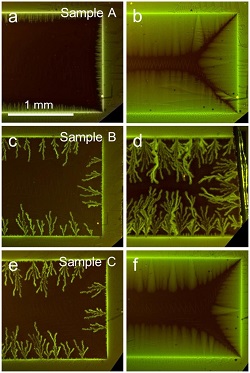
Image – Scientists at Ames National Laboratory measured magnetic field lines progressing into niobium films, using magneto-optical spectroscopy. This measurement is part of a larger research effort to analyze quantum materials down to the atomic level. With the data they collect, they hope to improve the reliability of circuits used in quantum computing. Courtesy of: Acta Materialia (2024).
For more information:
Ames National Laboratory