The U.S. Department of Energy’s (DOE) Argonne National Laboratory in Illinois announced the creation of an innovative set of methods to evaluate long-term aging in real-world battery cells. The methods their researchers developed and demonstrated are based on nuclear magnetic resonance (NMR) spectroscopy.
This is the first-ever NMR spectroscopy capability that can track in fine detail how the chemistry of commercial pouch battery cells evolves over years of operation.
Today’s lithium-ion batteries work by electrolytes transporting lithium ions back and forth between two electrodes, converting stored energy into electricity. Most lithium-ion batteries in electric vehicles have anodes (negative electrodes) made of graphite. However, new electrode materials with higher energy densities, such as silicon, are needed for longer driving ranges.
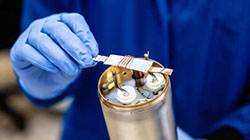
In the Argonne study, researchers developed and applied the NMR spectroscopy technique to observe the fate of lithium atoms in silicon-anode cells as they were charged and discharged, then allowed to rest over seven months. The technique is similar to magnetic resonance imaging, or MRIs, used in medicine to create detailed images of the body.
The team made an important discovery: after the cells charged, many lithium atoms were getting trapped in the anode. During discharge, lithium atoms remained in the anode in the form of lithium silicides rather than being removed and transported to the cathode (positive electrode).
The trapped lithium silicides accumulated in the anode, depleting the total amount of lithium available for cycling the cells. They also reacted with the electrolyte. The trapped molecules and reactions contributed to reductions in the cell’s energy-storage capacity.
The Argonne team also found that adding a magnesium salt to the electrolyte decreased the amount of trapped lithium silicides. These findings are likely to inspire new lines of research to identify different chemical additives, electrolyte formulations and silicon materials that can limit the formation of trapped lithium silicides.
The new NMR methods are thus not limited to silicon-anode batteries. They can easily be applied to other emerging battery technologies like sodium-ion and solid-state. They can also probe aging in other battery components like cathodes and electrolytes.
Image – Image of the NMR probe (the metal cylinder) and a small-scale battery pouch cell (the rectangular device on top of the probe) used in the Argonne study. Courtesy of Argonne National Laboratory.
************
For more information:
Argonne National Laboratory