Another disadvantage of thermal spraying is that it is a line-of-sight process. Thermal spray deposition of coatings on simple geometrical configurations is relatively straightforward. Complex geometries, such as gas-turbine airfoils, require automated, robotically-controlled manipulation of the gun and/or substrate to properly address the coating surface.
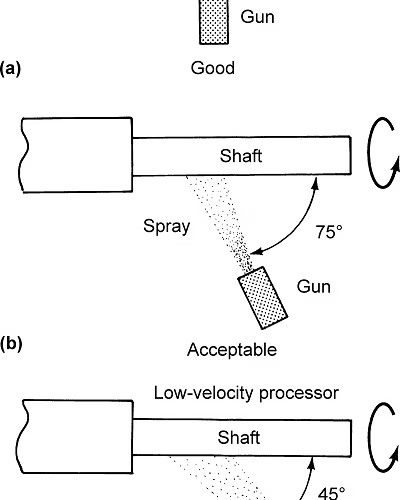
Deviation from spraying normal to the surface can compromise coating properties (Image a). As a rule of thumb, low-velocity spray processes need to stay within ±15° of normal (Image b). Higher-velocity processes can tolerate off-axis spraying up to ±45° (Image c). Porosity tends to increase and coating cohesion tends to decrease, along with deposit efficiency, beyond these limits.
Image – Thermal spray stream positions. (a) Good. (b) Acceptable. (c) Minimum acceptable. HVOF, high-velocity oxyfuel.
This information is from ASM Handbooks Online, Vol. 5A: Thermal Spray Technology, Coating Structures, Properties, and Materials. To find this information (subscription required), click on the link below and scroll down to Figure 3.
https://dl.asminternational.org/handbooks/edited-volume/12/chapter/134972/Introduction-to-Coating-Design-and-Processing