Fauchais et al. studied two liquid injection systems, SPS and SPPS, and compared these with a conventional feeding system via plasma spray. Both SPS and SPPS achieved a fine microstructure, with layers of thickness varying between a few micrometers up to a few hundred micrometers. The deposition rate was one-fifth to one-fourth of that for conventional plasma spraying; therefore, these techniques were deemed capable of manufacturing dense or porosity-controlled coatings and functionally graded layers.
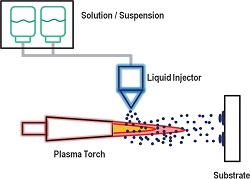
Gell et al. concentrated on the SPPS process to form thermal barrier coatings (TBCs). The deposition state of SPPS coatings was a function of the thermal history of solution droplets. This history was, in turn, a function of droplet entrainment in the plasma plume and can be extensively varied through injection parameters such as gas pressures and feed rates. The flexibility of the SPPS process was used to create TBCs up to 4 mm (0.16 in.) thick as well as TBCs of unique compositions. The image illustrates the SPPS delivery system.
Image – Schematic of the solution precursor plasma spray delivery system.
This information is from ASM Handbooks Online, Vol. 5A: Thermal Spray Technology, Coating Structures, Properties, and Materials. To find this information (subscription required), click on the link below and scroll down to Figure 23.
https://dl.asminternational.org/handbooks/edited-volume/12/chapter/133823/Feedstock-Material-Considerations-for-Thermal