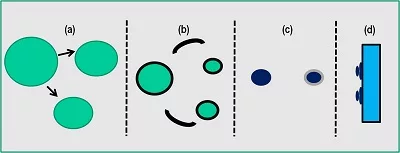
The phenomena occurring during solution thermal spraying are of physical and chemical natures and are therefore more complex than those of suspension spraying. The scanning electron microscopy observations after a single torch pass over the substrate enables visualization of spherical particles and cracked shells. The stages of the solution droplet in the plasma, shown in the image, can be summarized as aerodynamic breakup (a), heating and precipitation of solution (b), heating and melting of the solid, including evaporation from the melt (c), and impact with the substrate (d).
The initial droplets enter the plasma after primary atomization. The timescale of the secondary breakup corresponds to microseconds. The droplets then undergo rapid vaporization of solvent. Because diffusion of solute from the center of the droplet is slower than vaporization, the concentration of the solute on the droplet surface increases rapidly until the level of supersaturation is reached. Then, precipitation of a solid shell starts.
Image – Phenomena at flight of a solution droplet in a high-temperature plasma or flame.
This information is from ASM Handbooks Online, Vol. 5A: Thermal Spray Technology, Coating Structures, Properties, and Materials. To find this information (subscription required), click on the link below and scroll down to Figure 26.
https://dl.asminternational.org/handbooks/edited-volume/12/chapter/133823/Feedstock-Material-Considerations-for-Thermal