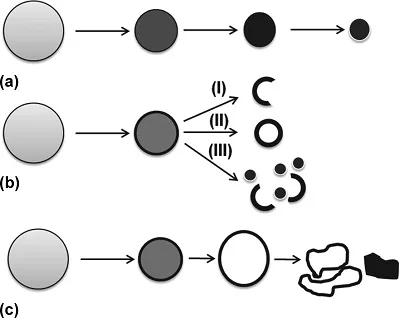
The initial droplets enter the plasma after primary atomization. The timescale of the secondary breakup corresponds to microseconds. The droplets then undergo rapid vaporization of solvent. Because diffusion of solute from the center of the droplet is slower than vaporization, the concentration of the solute on the droplet surface increases rapidly until the level of supersaturation is reached. Then, precipitation of a solid shell starts. The following three routes are possible:
- Uniform concentration of solute and volume precipitation, leading to formation of solid particles (Image (a))
- Supersaturation near the droplet surface, followed by formation of an inelastic shell that may be fragmented or not, depending on the permeability of the shell. If the permeability through the shell is low, see route I in Image (b); for a high-permeability shell, see route II in Image (b). If an impermeable shell is formed, then internal heating, pressurization, and subsequent shell breakup occur, followed by the atomization of the internal liquid; see route III in Image (b).
- Supersaturation near the droplet, followed by formation of elastic shell formation, deflation, and deflation by solid consolidation, as in Image (c).
The evaporation rate can be found by taking into account the Raoult law for the individual vapor pressure of each component of the solution, as well as the Clausius-Clapeyron equation to take into account the variation of vapor pressure with temperature.
Image – Vaporization and precipitation routes for a solute droplet.
This information is from ASM Handbooks Online, Vol. 5A: Thermal Spray Technology, Coating Structures, Properties, and Materials. To find this information (subscription required), click on the link below and scroll down to Figure 27.
https://dl.asminternational.org/handbooks/edited-volume/12/chapter/133823/Feedstock-Material-Considerations-for-Thermal