Scientists from the Research Center Future Energy Materials and Systems of the University Alliance Ruhr, Germany, used state-of-the-art microscopy and simulation techniques to systematically observe how iron atoms alter the structure of grain boundaries in titanium. They were surprised by the results: “Iron atoms not only segregate to the interface, but they form entirely unexpected cage-like structures,” explains Prof. Christian Liebscher, lead of the international research team. The researchers did not expect such a behavior.
Most technological materials have a polycrystalline structure, where atoms are arranged in a regular lattice. These crystals do not have the same orientation everywhere and the interfaces separating them are known as grain boundaries.
The key to success was to observe and model the structures at atomic resolution. The researchers correlated their results from atomic-resolution scanning transmission electron microscopy with advanced computer simulations. A new grain boundary structure prediction algorithm was able to generate the experimentally observed structures and enables the study of their structure.
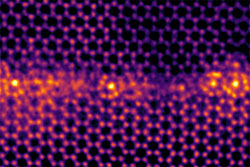
A closer inspection of the cage structures revealed that the atoms adopt an icosahedral arrangement (a geometric object with 12 corners or vertices and 20 planes) with iron atoms being located at the center of the icosahedron and titanium atoms occupying its vertices.
“The icosahedral cages enable a dense packing of iron atoms and since they can form aperiodic clusters, more than two to three times the amount of iron can be accommodated at the grain boundary,” explains Vivek Devulapalli. “This is attributed to the properties of the icosahedral cages”, adds Liebscher, “and we now need to find ways to study how they influence the interface properties and with this the material behavior.”
Understanding and controlling the formation of icosahedral grain boundary phases with different structures and properties can potentially be used to tailor the properties of materials. The researchers now want to systematically investigate how these novel grain boundary states can be used to tune material behavior, adjust a certain material functionality and to make materials more resilient against degradation processes. Their findings have been published in the journal Science (“Topological grain boundary segregation transitions”).
Image – Atomic resolution scanning transmission electron microscopy image of icosahedral cage clusters (golden regions) at a grain boundary in titanium. The bright golden atomic columns inside the cages are composed of iron atoms. Courtesy of Science.
************
For more information:
University Alliance Ruhr