Researchers at Sandia National Laboratories, Albuquerque, N.M., tested a variety of nickel mixtures as protective coatings to shield stainless steel from the corrosive threats posed by sea air. They found that the material applied and the application process used impacted the properties of the coating, including how protective it was against corrosion.
As anyone who has lived near the ocean can attest, metal and sea mist are a recipe for corrosion. A nuisance of coastal life, the consequences of these common chemical reactions become far more serious when it is taking aim at the stainless-steel canisters that contain spent nuclear fuel.
Spent nuclear fuel is stored in quite a few coastal areas, where sea breezes can buffet canisters and deposit corrosive chloride salts such as sodium chloride, or more commonly known as table salt. Given enough time, the brine formed by these salts can corrode and pit stainless-steel canisters.
Researchers at Sandia and Pacific Northwest National Laboratory started exploring crack mitigation and repair technologies three years ago. These researchers, including engineer Erin Karasz, who started the project as a postdoctoral appointee and is now staff and lead researcher, have tested a variety of cold spray coatings to see if they could protect 1/2-inch-thick pieces of stainless steel from chloride corrosion.
“We found that you have to be very cognizant of the kind of material you are spraying onto what other kind of material,” said Karasz. “I was surprised at how much the porosity determined the behavior when corrosion got going in between the cold spray coating and the steel. There seems to be a specific level of porosity, below which the cold spray has enhanced corrosion resistance.”
The team tested three different nickel-based metal mixtures, two with known anti-corrosive properties and pure nickel as a comparison. They tried two different gases, nitrogen and helium. And they tested the effect of tapering off the coating on the metal or leaving a sharper edge between the coated area and the uncoated area.
They found that the gas used to spray on the metal particles had a strong impact on how porous, or spongy, the coating was. The porosity of the coating greatly impacted the corrosion behavior of the coating.
To test the corrosion protection of the cold spray coating, Karasz soaked the small pieces of cold-spray-coated stainless steel in a very corrosive ferric chloride bath for three days. This is a standard method to speed up chloride corrosion, but it isn’t a perfect model of what would occur to spent nuclear fuel canisters over hundreds of years. They found corrosion on all the samples, but the location and shape of the corrosion differed, suggesting further refinement of the coatings is needed.
Now the team is testing stainless steel with cold spray as well as other polymer coatings under more relevant atmospheric conditions. Eventually, the goal is to test the coatings on welded stainless steel to test them with stress and corrosion. Cold spray is a newer technique and very few people have looked at it under atmospheric corrosive conditions, let alone its corrosion performance over hundreds of years.
Results were published in the scientific journal Frontiers in Metals and Alloys.
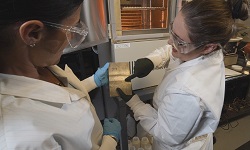
Image – Sandia National Laboratories researchers Rebecca Schaller, left, and Erin Karasz discuss the results of a stainless-steel corrosion test. Click to watch a video about the team’s stress corrosion cracking research. Courtesy of: Ruth Frank.
For more information:
Sandia National Laboratories