A team of scientists from Fraunhofer IZFP, Germany, has developed a new measuring system for the aluminum industry to detect contamination in molten metal—an important tool during the production process.
“The purity of the molten metal, whose temperature ranges from 600° to 800°C, is hugely important to the final product later on. For example, any ceramic particles that may be present in the melt don’t liquefy until they get to a temperature of 2000° or more, and they remain in the finished component as inclusions if they aren’t deliberately removed.
“This can lead to cracks and holes, and thus in the worst case to component failure,” says Thomas Waschkies, chief scientist for Sensor Physics at Fraunhofer IZFP. From the start, he headed the project jointly with his colleague Andrea Mross, who now works in the area of strategy and research programming at the institute in Saarbrücken.
After steel, aluminum is the most widely used metal worldwide. It plays a major role in climate neutrality due to factors including its use in lightweight construction. It also requires little energy input to recycle, so it is a pivotal element of the circular economy.
Various measurement systems are already available on the market for quality control when working with molten aluminum, but they are expensive, can only be operated by specially trained experts or are highly time-consuming to use, and thus only spot checks are possible. This means the industry needs a low-cost system that can be operated without special knowledge, delivers final results quickly and can be used flexibly in foundry settings.
This was the background for the idea, born at Fraunhofer IZFP, of a mobile, ultrasound-based measurement system for molten aluminum. The AloX project was launched, with a name derived from “aluminum melt” and “oxide inclusions.” How the system works can be described using an everyday analogy.
“It’s a lot like a parking sensor in a car in that the system, immersed in the molten metal, transmits signals that then bounce off a reflector. If any particles—meaning contaminants—float by, there is a disruptive signal,” Mross explains. Those signals make it possible to take action right there on the production floor to assure quality.
The challenge in developing the system lay first and foremost in the extreme conditions prevalent in the foundries where it is intended for use. The hot molten metal radiates a great deal of heat, affecting not only the system itself but also the entire load-bearing unit. Molten aluminum is also highly corrosive to metal materials.
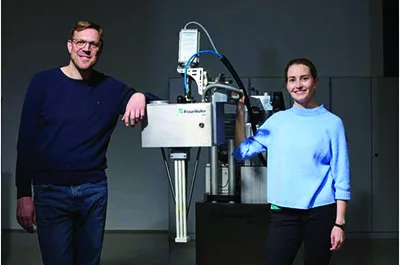
Working closely with industry, the team ultimately developed an initial prototype. The measuring trolley features a measuring unit equipped with special ultrasonic waveguides and built-in cooling, along with a specially developed software program with a patented analysis algorithm. The change mechanism for the ultrasonic waveguides made from titanium is also patented at this point.
The next step for the researchers will be moving the system into broad industrial application, initially in aluminum production. But other potential uses are also conceivable, such as for quality control of other types of molten metal.
Image – Thomas Waschkies and Andrea Mross received the 2025 Joseph von Fraunhofer Prize developing the AloX mobile ultrasound-based measuring system. Courtesy of Fraunhofer-Gesellschaft.
************
For more information:
Fraunhofer-Gesellschaft