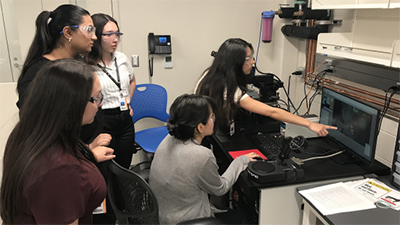
Six undergraduates at the University of Illinois Chicago (UIC) have been developing a process to accelerate the creation of diamond membranes, which are crucial for hosting qubits, the fundamental units of quantum information. This work is part of the research at Q-NEXT, a U.S. Department of Energy National Quantum Information Science Research Center led by Argonne National Laboratory. During their 10-week internship at Argonne, the students wrote software to automate a labor-intensive part of diamond-membrane production, finding the experience both challenging and rewarding.
Their work is enabled through Break Through Tech Chicago, an initiative that provides women and nonbinary people with internship opportunities in science and technology. Argonne staff scientist Nazar Delegan, a Q-NEXT collaborator, and UIC professor Dale Reed led the student team.
Quantum information technologies are expected to revolutionize areas such as logistics, drug development and navigation in the coming decades. Diamond membranes are a new material for hosting qubits, the core of quantum devices. The membranes have desirable properties for quantum information processing, and they open paths for integrating quantum materials with current information technologies.
Scientists are investigating the most effective ways to fabricate diamond membranes. One of the production steps — a specific process in the etching stage — requires up to 60 minutes of continual human effort and supervision.
The task before the UIC students: Put that etching process on the path to full automation.
“There are factors that can disrupt the etching process. Someone has to constantly be checking that it’s being done right,” said Fernanda Villalpando, an information decision sciences senior and the group’s project manager. “So we worked to automate it.”
By demonstrating proof of concept, the students laid the groundwork for the procedure so that future researchers can scale it up to industry production levels.
The membranes are created by embedding a layer of graphite between two layers of diamond. The thick bottom diamond layer serves as a platform. The tissue-thin top layer — 100 to 1,000 nanometers thin, a hundred to a thousand times thinner than a sheet of paper — is the diamond membrane. Scientists use electrical probes to chemically etch away the graphite beneath the membrane, which can then be peeled off and integrated into a quantum device.
Currently, a human must watch over the roughly hour-long etching process to ensure its successful execution. But following the UIC group’s work, researchers will one day be able to say goodbye to human-supervised etching.
Building on image detection software called Open CV as part of the Python programming language, the students created a program to teach the computer to visually assess and respond to the etching process. Is there a bubble trapped between layers? An unexpected obstruction? With the UIC group’s program, the computer knows whether to stop the etch, continue or work around it.
“That way, the scientists don’t have to be there to push the ‘off’ button, for example,” Villalpando said. “Our program stops it for them.”
As the ones spearheading the procedure, the team had no blueprint for how to proceed. They quickly realized they’d have to draw heavily on their computer science knowledge, hunt for relevant documentation and even pick up the phone to call the device’s manufacturer for minutiae not captured in the literature.
“We had to reach out to the company. It was a little frustrating, because how were we going to do the rest of the work if we’re having trouble communicating with the devices?” said Claudia Jimenez, a computer science junior. “But once we got that part, we had the persistence and resilience to keep going, and made a lot of progress in two or three weeks. We kept going and looked for different resources to accomplish something that none of us had ever done before.”
In fact, it was something no one had done before. Currently, only a select few groups in the world are creating diamond-membrane qubit platforms.
“I love being in a space where everyone is excited about it,” Villalpando said. “I’ve been in rooms where people do the work that they do all the time. It’s not new, and there’s only one way to do it. But we get to be creative and think, ‘How can we solve this?’”
For Q-NEXT, the group’s development of a technical procedure from scratch was a crucial contribution to quantum materials fabrication. For the students, it was part of the real-world work of experimenting in a laboratory.
The Chicago Quantum Exchange honored the group’s work with the Best Undergraduate Student Poster Award at the Chicago Quantum Summit in October.
The UIC team was also excited to be part of game-changing research that could have impacts across so many areas of everyday life.
“Quantum applies to so many different applications and fields and industries. I would possibly like to be a part of that. It was nice to hear from actual professionals in the field giving an explanation about what quantum is, how it can be applied and how we’re actually going to do it,” Jimenez said.
For more information: Q-NEXT
Image: UIC students work at the Argonne Quantum Foundry through the Break Through Tech Chicago program, helping automate an important step in the production of diamond membranes for qubits. (Image by Argonne National Laboratory.)