Scientists from Lawrence Livermore National Laboratory (LLNL), Livermore, Calif., delved into the mysterious world of pitting corrosion in additively manufactured (3D-printed) stainless steel 316L in seawater. Stainless steel 316L is a popular choice for marine applications due to its excellent combination of mechanical strength and corrosion resistance. This holds even more true after 3D printing, but even this resilient material isn’t immune to the scourge of pitting corrosion. The LLNL team used transmission electron microscopy and x-ray photoelectron spectroscopy to do a deep-dive microscopy study to figure out what could potentially be responsible for corrosion.
The team discovered the key players in this corrosion drama are tiny particles called “slags,” which are produced by deoxidizers such as manganese and silicon. In traditional stainless steel 316L manufacturing, these elements are typically added prior to casting to bind with oxygen and form a solid phase in the molten liquid metal that can be easily removed post-manufacturing. Researchers found these slags also form during laser powder bed fusion (LPBF) 3D printing but remain at the metal’s surface and initiate pitting corrosion.
While slags also can form during traditional stainless steel manufacturing, they’re typically removed with chipping hammers, grinders or other tools. Those post-processing options would defeat the purpose of additively manufacturing (AM) the metal, said the researchers, who added that prior to their study, there was almost no information on how slags are formed and deposited during AM.
To help address these unanswered questions, the team used a combination of advanced techniques including plasma-focused ion beam milling, transmission electron microscopy and x-ray photoelectron spectroscopy on AM stainless steel components. They were able to zoom in on the slags and uncover their role in the corrosion process in a simulated ocean environment, finding they created discontinuities and allowed the chloride-rich water to penetrate the steel and wreak havoc. Additionally, the slags contain metal inclusions that dissolve when exposed to the seawater-like environment, further contributing to the corrosion process.
Using transmission electron microscopy, the researchers selectively lifted small samples of 3D-printed stainless steel from the surface—about a few microns—to visualize the slags through the microscope and analyze their chemistry and structure at atomic resolution, according to lead investigator Thomas Voisin. The characterization techniques helped shed light on the complex interplay of factors that lead to pitting corrosion and enabled the team to analyze slags in ways never done before in AM.
Now that the team understands the causes behind pitting, their next steps to enhancing the performance and longevity of 3D-printed stainless steel 316L would be altering the formulation of the powder feedstock to remove manganese and silicon, to limit or eliminate slag formation.
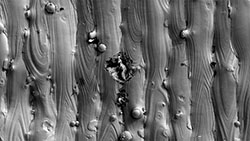
Image – This photo, taken by a scanning electron microscope, shows a pit at the surface of an additively manufactured (3D-printed) stainless steel part. Courtesy of Thomas Voisin.
************
For more information:
Lawrence Livermore National Laboratory