An $11.5 million sponsorship will launch a new research institute at Tufts focused on materials science and engineering. The Tufts Epsilon Materials Institute is a collaboration between manufacturer Epsilon Group, India, and the university to advance innovations in materials that address global challenges in energy and sustainability.
The institute reflects the vision of Vikram Handa, managing director at Epsilon Group. Epsilon Group is a leading industrial conglomerate driving innovation in the carbon black and in sustainable, high-performance advanced battery materials that power electric vehicles and energy storage systems.
“The establishment of the Tufts Epsilon Materials Institute is a proud moment for me as a Tufts alumnus and a significant step toward our mission to drive sustainable innovation,” said Handa, who is a member of the School of Engineering’s Board of Advisors.
“This collaboration strengthens our commitment to R&D in high-performance battery materials, supporting the growing demand for sustainable energy solutions in the U.S.,” Handa added. “Our investments in the U.S. will build a robust supply chain for energy transition by innovating in advanced materials and enhancing material circularity. We believe this institute will foster the collaboration needed between academia and industry to address the global energy challenges we face today.”
Epsilon Group’s focus on sustainability aligns with the university’s commitment to clean energy solutions, said Tufts University President Sunil Kumar.
“Creating impactful solutions for today’s energy challenges requires a purposeful, collective vision and dedicated researchers to realize that vision,” he said. “The institute will help us achieve those goals and chart a course for future growth and impact. Together we will translate academic research into immediate, tangible, commercial applications that will power new directions in the energy industry.”
The sponsorship funds three new faculty positions at the School of Engineering and establishes seed funding to support future collaborations that focus on developing cleaner, safer, and more sustainable energy solutions.
“Investments in faculty are critical for our research capacity,” said Kyongbum Lee, School of Engineering dean and Karol Family Professor. “As we elevate and leverage our expertise in materials science and engineering, the institute will become a hub of innovative research, attract world-class faculty, students and postdocs, and enable discoveries that will directly address pressing challenges in moving toward socially responsible, sustainable economies.”
Potential research areas include the development of renewable material-based batteries that support a circular economy, in which resources are kept in use for as long as possible through repair, reuse, remanufacture, and recycling.
Currently two faculty in the Department of Chemical and Biological Engineering, Matthew Panzer, professor and dean of research for the School of Engineering, and Graham Leverick, assistant professor, are focused on materials chemistry of novel electrolytes. Their research provides the foundational knowledge needed to develop the next generation of highly efficient energy storage devices, innovations considered essential for reducing dependence on fossil fuels.
Panzer looks forward to seeing the institute advance the field of materials science and support the global shift toward electrification. The next generation of electrochemical devices, he said, must move society away from a disposable mindset. Materials such as lithium used in electric vehicle batteries, for example, are finite resources that must be recovered and reused responsibly, he said.
One of the technologies that could displace some of the lithium is sodium, a material with many similar properties. Sodium ions are critical to biological processes and sodium is far more abundant and cheaper than lithium.
“We will continue to develop additional battery chemistries,” Panzer said. “Sodium ion is one—there will probably be others too—but we need strategic materials design principles that recognize the need for built-in circularity.”
Handa’s career has followed an upward trajectory of its own as he has driven innovations in the carbon black and battery materials industry. The industry includes the production, processing, and application of carbon black, which plays an instrumental role in elevating the performance of lithium-ion batteries.
In 2010, he founded Epsilon Group, an industrial conglomerate. Its subsidiaries include Epsilon Carbon and Epsilon Advanced Materials, which Handa founded in 2018 to meet the growing need for more sustainable approaches to the production of battery anode and cathode materials.
“Instead of relying on fossil fuels, battery power has emerged as a viable option” for consumer electronics, energy storage, electric vehicles, and other uses, he said. “Despite the increasing interest in battery power, the supply and quality of battery materials has not yet caught up with the growing demand.”
A truly effective clean energy transition depends on tackling complex questions related to materials science, such as how to improve clean energy storage and delivery and how to reduce the environmental impact of industrial and household goods, from manufacturing through disposal.
Now, solving those and other challenges will be among the top priorities of the Tufts Epsilon Materials Institute, Handa said.
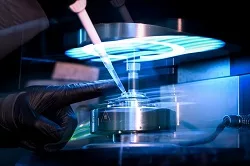
Image – Assistant Professor of Chemical and Biological Engineering Graham Leverick pipettes liquid battery electrolytes into a rheometer, an instrument that uses pressure and rotation to measure the mechanical properties of these polymer-based electrolyte materials—the “slurries”—used to make battery electrodes. Courtesy of: Alonso Nichols/Tufts University.
For more information:
Epsilon Group
https://www.epsilonam.com/
Tufts University
https://www.tufts.edu/