The European Space Agency has joined forces with other leading research institutions and more than 180 European companies in a billion-euro effort developing new types of metals and manufacturing techniques for this century. Known as Metallurgy Europe, the seven-year international research and development program was launched at London’s Science Museum.
“We’ll be laying the technical foundations for the discovery of new materials – metallic compounds, alloys, composites, superconductors and semiconductors,” explained David Jarvis, Head of Strategic and Emerging Technologies at ESA and Chairman of Metallurgy Europe.
“We’ll also be applying computer modelling to guide our alloy creation, as well as advanced manufacturing techniques, such as additive manufacturing or 3D printing, for the creation of new products.”
From the Iron Age to the Nuclear Age, metallurgy has been a driving force in human history. The various branches of the metals-related industry today accounts for 46% of the EU’s manufacturing value and 11% of its total Gross Domestic Product – equivalent to $2.1 trillion annually or $5.7 billion daily.
Metallurgy Europe is conservatively projected to create at least 100,000 new jobs, based on the 10 million people today employed by the metals and end-user industries across the EU plus Switzerland and Norway.
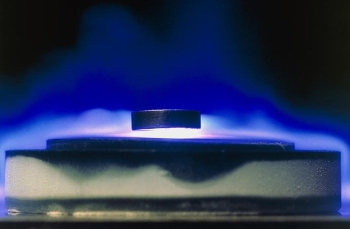
Organized along 13 topics, the potential results include novel heat-resistant alloys for space and nuclear systems, high-efficiency power lines based on superconducting alloys, thermoelectric materials converting waste heat into power, new catalysts for the production of plastics and pharmaceuticals, bio-compatible metals for medical implants, as well as high-strength magnetic systems.
Lightweight alloys and composites for the aerospace and automotive industries could potentially slash the weight of spacecraft components, as well as reduce today’s two-tonne cars by more than half.
“The periodic table gives us around 60 commercial metal elements,” Prof. Jarvis explained. “In the world of materials it’s the mixing of these different chemical elements that is vital to us: we hardly use pure metals but we do use compounds, alloys and composites.”
A standard laptop might combine more than 20 different metal elements, while putting a spacecraft into orbit typically incorporates upwards of 50 elements, including the rocket, the satellite and all its subsystems, its electronics and the functional materials that go in there.
“You’ve got those 60 elements and you can mix them in so many different ways,” he added. “The actual number of combinations and ratios of mixing elements is infinite—we’ve only really scratched the surface.”