Researchers at Kobe University, Japan, in partnership with National Chung Hsing University, Taiwan, developed a new electrical power converter design that provides considerably better efficiency at reduced cost and maintenance than before. This direct current voltage boost converter is expected to advance electric and electronic components for power production, healthcare, mobility, and information technology.
One essential component connects all devices that generate energy from vibrations or sunlight, or power medical equipment or hydrogen-powered cars. A “boost converter” transforms an input of low-voltage direct current into an output of high-voltage direct current.
Given its commonality and importance, it should work at maximum efficiency while producing no heat or electromagnetic noise, using the fewest number of parts feasible to minimize maintenance and costs.
The primary operating concept of boost converters is to rapidly switch between two states in a circuit, one that stores energy and one that releases it. The faster the switching, the smaller the components may be; therefore, the whole device can be reduced in size. However, this increases electromagnetic noise and heat production, reducing the power converter’s performance.
Tomokazu Mishima, a power electronics researcher at Kobe University, and his team developed a novel direct current power conversion circuit. They combined high-frequency switching (approximately ten times greater than before) with a technique known as “soft switching,” which decreases electromagnetic noise and power losses due to heat dissipation while simultaneously reducing the number of components, lowering cost and complexity.
Traditionally, this has been accomplished via “snubbers,” components that provide alternate energy sinks during the transition phase, resulting in energy losses.
“When the circuit changes between two states, there is a brief period when the switch is not completely closed, and at that point, there is both a voltage and a current across the switch. This means that during this time, the switch acts like a resistor and thus dissipates heat. The more often a switch state changes, the more this dissipation occurs. Soft switching is a technique that guarantees that the switch transitions happen at zero voltage, thus minimizing the heat loss,” says Mishima.
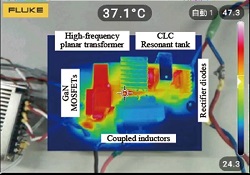
The key to success is the teams’ use of “resonant tank” circuits, which can store energy throughout the switching time and have significantly reduced losses. They also use a component-saving design with flat components printed onto a circuit board known as a “planar transformer,” which is highly compact and has good efficiency and thermal performance.
The team created a circuit prototype and tested its performance. “We confirmed that our snubberless design has much reduced electromagnetic noise and a high energy efficiency of up to 91.3 percent, which is unprecedented for a MHz drive with high voltage conversion ratio. This ratio is also more than 1.5 times higher than existing designs,” Mishima says.
Mishima noted, “The current development is a 100W-class small-capacity prototype, but we aim to expand the power capacity to a larger kW-class capacity in the future by improving the electronic circuit board and other components.” They also intend to improve efficiency by lowering the power dissipation of the magnetic components used.
Given how commonplace electrical devices are in everyday life, a direct current power supply with a high voltage multiplier ratio must operate with outstanding efficiency and low noise. Applications in electric power, renewable energy, transportation, information and telecommunications, and healthcare will benefit significantly from this Kobe University development.
The Kobe University team published its innovative circuit design and assessment in the IEEE Transactions on Power Electronics journal.
Image – The Kobe University-developed direct current voltage boost converter has much reduced electromagnetic noise and a high energy efficiency of over 91 percent, which is unprecedented for an MHz drive with a high voltage multiplier ratio. This ratio is also more than 1.5 times higher than existing designs. Courtesy of: Tomokazu Mishima.
For more information:
Kobe University
National Chung Hsing University
https://www.nchu.edu.tw/en-index