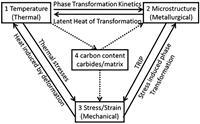
Some of the main interactions that occur during the heat treatment of steel alloys including temperature, microstructure, and stress/strain. Especially for tool steels these interactions are mainly influenced by the carbon content in the steel matrix, the types and relative amounts of the alloying elements, and the carbide formation/transformation/precipitation characteristics of the alloy system.
Heat treatment involves changes of temperature with time, which determine changes in microstructure. The rate of temperature change results in a change of microstructure which is described by phase transformation kinetics, as in e.g. TTT (time-temperature-transformation) diagrams; every phase transformation releases/absorbs latent heat, which influences the temperature field. An inhomogeneous temperature distribution, i.e. temperature gradients, within the tool during heat treatment can generate thermal stresses that lead to plastic deformation, if the yield strength of the material at that temperature is exceeded. Every mechanical deformation generates heat which, in turn, influences the temperature field. Furthermore, there is an interaction between the stress state and the microstructure. Phase transformations can result in micro-plastic deformation, which can be globally described using transformation plasticity models.
For more information, click on the link below (subscription required). Then scroll to Figure 2. R Schneider; R. Mesquita; W Schützenhöfer, Distortion in Tool Steels, ASM International, 2014 https://doi.org/10.31399/asm.hb.v04d.a0005980