An international research collaboration, including a group from Cornell Engineering, has used a new X-ray-based reconstruction technique to observe topological defects in a nanoscale self-assembly-based cubic network structure of a polymer-metal composite material over a large sample volume for the first time. This technique and the new insights gained could be applied to studying other mesoscale structures with similar defects, which underpin many physical phenomena and can lead to new or enhanced material properties in both natural and synthetic self-assembled materials. Ulrich Wiesner, the Spencer T. Olin Professor in the Department of Materials Science and Engineering, emphasized that this new polymer, structure, and technique allow for unprecedented sample volumes to be reconstructed, enabling detailed examination of defect structures and their frequency.
The question regarding the importance of defects in BCP SA-generated materials has always been elusive, Wiesner said, in part because technologies necessary to measure large-enough sample volumes – with correspondingly larger defect structures – have been slow to develop.
The new technology – hard X-ray ptychography, which was conducted at the Swiss Light Source (SLS), at the Paul Scherrer Institute in Switzerland – is an advanced form of tomography that can penetrate deeper into a material than is possible with beams in electron microscopes. This technique allowed the researchers to reconstruct a very large sample volume of a BCP SA-derived polymer-metal composite material.
“If you have a smaller defect such as a line or a point defect, when you perturb the system, often you can ‘correct’ the defect structure,” Wiesner said. “In contrast, topological defects are so large, they are very stable against external perturbations.”
Once the triblock terpolymer was synthesized, researchers in the group of Ulli Steiner at the Adolphe Merkle Institute in Fribourg, Switzerland, a long-time collaborator of Wiesner, generated thin films from it and replaced one of the terpolymer blocks with gold, so the material could withstand repeated exposure to the intense coherent X-ray beams at SLS.
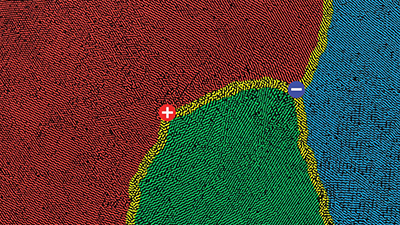
Imaging and image reconstruction at the SLS finally revealed a co-continuous network known as a single-diamond structure, with topological defects that the researchers expect would have substantial effects on mechanical and other properties. Importantly, the defects most closely resemble topological textures found in nematic liquid crystals and in Hydra single-celled organisms, suggesting that self-assembly can be used as a model process to investigate the role of topology in nature.
Wiesner said this collaborative research could pave the way for future studies in an area that his lab has already explored: block copolymer-directed superconductors.
“You would expect that your macroscopic, electronic or transport properties of the superconductor will depend on defects in your materials,” he said. “That’s what I’m really excited about: Now we have a technique that allows us to visualize larger volumes of these materials and to generate defect structure – property correlations.”
For more information: Nature Nanotechnology
Image: Pictured is a two-dimensional, cut-through reconstructed sample volume showing three adjacent crystal grains (red, blue, green) separated by a 100-nanometer-thick grain boundary (yellow) together with the positions of two topological defects (plus and minus signs).